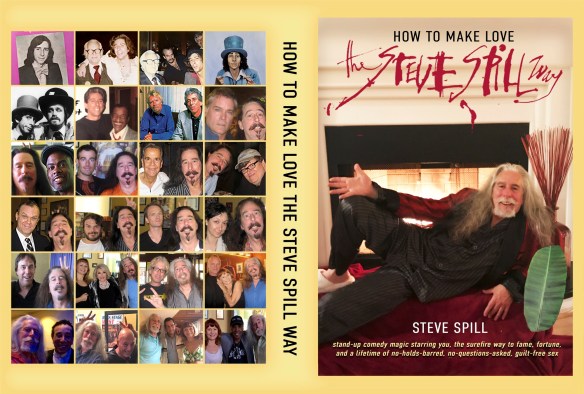
How To Make Love The Steve Spill Way

COVER_v2

***

If Lenny Bruce were a magician, he would be Steve Spill.

Lenny has long since passed onto that great big comedy stage in the sky, but fortunately our friend Steve Spill is alive and well and has come out with a new book aimed at magicians called How To Make Love The Steve Spill Way. His first book, I Lie For Money, was aimed at a general audience and contained lots of advice on how to live a creative life. It was served along with large dollops of autobiography and spit-take funny stories about the people he met along the path while building an artistic life for himself. In this new book, Steve not only continues his general advice for would-be artists, but also gives up the details of a dozen of his most creative and hilarious tricks. It would be an understatement to say that I think everyone interested in performing magic should read this book.

It’s always a great gift when a wonderful performer tips the secrets of his act, but it’s an even greater gift when the performer himself does the literate and humorous writing chore. Because it’s in that act of writing that Spill divulges his biggest secret: the most powerful thing a performer can do is to find her or his own quirkiness and unique qualities and put them out on display in a performance-oriented way.

When you read one of Spill’s books, you instantly understand what he’s talking about when he says to trust your own personality, because the pages of his books are drenched in the unique persona which he has nurtured. While on the one hand it’s instructive to pick up a Dai Vernon book written by someone like Lewis Ganson, on the other hand, the fact that Ganson, not Vernon, wrote it deprives the reader of real insight into much of Vernon’s personality. With a writer like Steve, though, it’s all hanging out there, and it’s plain as day. You understand immediately that the twelve killer presentations that Spill has detailed are perfect for Spill. Those who are not Steve would most likely fall on their faces if they did his presentations verbatim, but that’s not the point. The point is…who are you?

There are so many lessons to be learned here, not the least of which is the courage of one’s convictions. I read the beginning chapters twice, because the first time through I was laughing too much at the jokes to pay attention to the content.

But if you’ve got as warped and crazy a mind as Steve does (that’s a compliment, I think) there are bound to be doubts about whether anyone else will appreciate what you’re doing. However, Steve’s examples of himself being true to form, along with his constant brainstorming, testing, discarding, and revising of effects, serve as a model of what can be done, and act as a spur to one’s own creativity.

For each of the twelve effects Spill describes, he gives the background story on how and why he created it, and these stories are useful adjuncts to understanding how to create your own effects. The methods are tried and true, and for the most part they probably won’t surprise you with their cleverness after the fact. But that’s not what Steve is after—what will surprise and delight you is the way that Steve takes an effect from column A and a presentation from column Z, and juxtaposes them to create something never seen before, something to amuse and mystify an audience, which leaves them with the impression of a strong magical personality and experience.

What’s in the tricks section? Well it’s a compilation of Spill’s greatest hits—The Lemon thing, the Needle thing, The Himber Ring thing, the drug and hemorrhoid jokes, they’re all there, with full scripts and extra handling  and performance tips explained with loving care. The most audacious routine is one called “Abra Cadavers” which involves, well, a tale of cadavers wrapped in a personal story of tragedy. You would have to be nuts to perform it. I’m happy to report that Spill has done it many times, and tells you how to do it so that you too can be the object of abject speechless horror. I also thought that the presentation given for the UltraMental Deck was one of the best ideas for it I’ve ever come across.

At the end of the nineteenth century, the British magician David Devant expressed his appreciation of his audience with the tagline, “All Done By Kindness.” Likewise, Devant’s American contemporary, Howard Thurston, would prepare to go onstage by intoning in the wings to an imaginary audience, “Thank you, thank you for coming to my show tonight. God Bless You.” And now in the same spirit, as we navigate the twenty-first century, Steve Spill urges us to make love The Steve Spill Way. His love for magic, his love for his audiences and for his unique self are all part and parcel of How to Make Love The Steve Spill Way.


The Cost

pablo-casals-2

***

Whenever I am envious of  the talent and skill of a great performing artist, I like to remember the following story, which the famous one-armed Spanish magician, Rene Levand, told in his book about his magic and life, Mysteries of My Life:

A man sees the great virtuoso cello player Pablo Casals crossing the street. The man, so thrilled to get a glimpse of his artistic idol, dashes across the street and manages to catch up with Casals.

“Maestro,” the man says, almost out of breath, “I just wanted you to know that I’d give my life to be you!”

Casals pauses and then replies drily, “I already did.”

Shin Lim Amazes Again

***

Shin Lim’s card magic raises the bar for everyone. It’s rare that card magic looks and feels magical, rather than just an intriguing puzzle or demonstration of skill.  Shin Lim’s performances give me that feeling of wonder.

Thanks to YouTuber Talent Recap


A Copperfield Virtual Tour

IMG_1387

***

***

The New-York Historical Society recently opened a small exhibition on the history of magic in New York, drawn from the vast private David Copperfield Collection. An unannounced surprise at the opening was the presence of Copperfield himself, who gave us a short guided tour of the exhibit (as Homer Liwag toiled in the background, putting last minute touches on the exhibit).

You can listen to Copperfield’s commentary, as broadcast yesterday on the Arts Express radio program on WBAI 99.5 FM, by clicking on the grey triangle above.

Sim*Sala*Bim!

IMG_1406

(Click to enlarge)

The magic words of Dante the Magician

New York Historical Society (from the David Copperfield collection)

New York, New York

His Master’s Voice

***

Given yesterday’s anecdote by Groucho concerning Houdini, I thought it would be fun to hear from Houdini himself. In 1914, magician Harry Houdini recorded the introductory patter for his Water Torture Cell effect onto the cylindrical records of Thomas Edison. The six cylinders are the only known examples of Houdini’s voice extant. The voice begins at 2:00, but watch all of it for the history.

Thanks to YouTuber houdinimuseum

When Groucho Met Houdini

Groucho

***

***

In 1972, Groucho did a one man show of reminiscences at Carnegie Hall  called An Evening With Groucho. In this short clip, he shares what happened when he encountered the magician Harry Houdini.

Click on the grey triangle to play.

Thanks to https://archive.org

Lying

IMG_1410

***

A new exhibit featuring a tiny fraction of the vast David Copperfield collection of magic opened today at the New York Historical Society. This was one of the fun things I got to do there.

(Note: this photo was taken with my Smartphone at the museum. No digital alteration has been applied to the photo.)

Carl Einar Hackner

***

Not really sure what they put in the water, but Swedish magicians are a whole different breed. You may be familiar with Lennart Green and Tom Stone, but Carl-Einer Hackner is also strangely brilliant.

Thanks to YouTuber MrLenny256

In & Of Itself: Derek DelGaudio

IMAG0590

(Click to enlarge)

***

Derek DelGaudio is a troubled and troubling man. And I mean that in the best possible way. DelGaudio’s low key demeanor may be studied, but he is not a man to be underestimated. In Derek DelGaudio’s one-man performance piece, In & Of Itself, he tells the familiar story of the six blind men confronted with an elephant, each of whom can only identify the elephant from his own perspective: the man at the elephant’s side perceives a wall, the man at the tail perceives a rope, the man at the legs feels a tree trunk, and so on. For the audience at any performance of DelGaudio’s play, they are facing an elephant.

For some it will be performance art, and for some it will be a play with inexplicable magic. For some it will be a meditation on identity and the process of labeling, while for others it will be a story about the power of stories. For others still, it will be a play about memory, and how the images that remain with us shape the rest of our lives.

Peter Brook in his short but influential book, The Empty Space, wrote this about live performance:

“When a performance is over, what remains?…The event scorches on to the memory an outline, a taste, a trace, a smell—a picture. It is the play’s central image that remains, its silhouette, and if the elements are highly blended this silhouette will be its meaning, this shape will be the essence of what it has to say.”

Derek DelGaudio takes this advice to heart. His stage setting is a space in which the back wall consists of six windows, each with a strong image: a gold mechanical head and torso with a gun in its hand; a bottle atop a pile of sand; a dog—or is it a wolf?—with a pack of cards in its mouth; a golden brick; a mailbox full of letters; and a set of scales. Each image takes DelGaudio further into the story of his lives and identities. He is generous enough and clever enough to make those of us in the audience take our own journey as well.

If this sounds vague, obscure, it is for a few reasons. To give away any of the specifics of the…experience—I think I’ll settle on that as the label for what happened on Saturday—would be to dilute the experience for others. And I’m not just talking about the magic components. In fact, the strongest aspect of DelGaudio’s piece for me was not even the magic, extraordinary as that was. It was DelGaudio’s view about the elephant story that resonated most for me—a perspective that goes beyond most re-tellings of that story and made me see the parable in an entirely different light. Would it be too strong to say that it has me off-balance still?

What is this thing? Well that’s what the show is about, and it’s hard to put a label on it. Well, imagine if Spalding Gray did sleight of hand…that would be two views of the elephant. DelGaudio is probably best known as a magician’s magician, but unlike many other magicians, you won’t see his work plastered all over YouTube. I do know that he and director Frank Oz have used all their skill to do something that most magicians never dream of. Derren Brown, the British magician and mentalist, in his recent US outing had a show called Secrets, which was a very good compilation of his greatest hits. It was clear, however, from Brown’s introductory remarks that he was reaching for something more, to explore the inner secrets of self. But Brown was not able to pull it off, and stayed safely within his skill set of stage magician. DelGaudio on the other hand, manages to convey the true feeling of revealing secrets—and not the ones that magicians keep locked up in some empty safe. He talks about the personal dilemma of having as a magician great skill that is never meant to be shown, and the personal toll that that takes; he talks about the secret of his childhood; he talks about what we can allow ourselves to know about ourselves. He talks about both the liberatory freedom and excruciating restraint that an affixed label gives a person.

But DelGaudio’s biggest trick is not just that he talks about it for himself, but in a stunning few moments near the end of the piece, a substantial portion of the audience gets the experience of deeply feeling their true and perceived identities.

Remember the opening to The Glass Menagerie? The narrator, Tom says, ““Yes, I have tricks in my pocket; I have things up my sleeve. But I am the opposite of a stage magician. He gives you illusion that has the appearance of truth. I give you truth in the pleasant disguise of illusion.”

That’s Derek DelGaudio. He is only playing until August 19th at the Daryl Roth Theater in NYC. If anything in this review sparked your interest, I would urge you to see him before it ends. There’s not going to be another one of his like again.


Billy Ray, Super Fly Cards Across

***

The stage version of the cards across magic trick has always struck me as something less than compelling, but this performance by magician Billy Ray [aka anesthesiologist Dr. Millard Brooks] has got to be one of the most entertaining magic acts I’ve seen.

Thanks to YouTuber Millard Brooks

Mixed Magic

***

Legend has it that “Buster” Keaton was given his monicker by Harry Houdini after he saw the young vaudevillian Joe Keaton being knocked around and taking pratfalls in his family stage act. Keaton always had a fondness for magic, and in 1936 he did a short two-reeler called Mixed Magic. The little known film, which can be difficult to track down, had Buster playing a magician’s assistant. The movie was a talkie and made after Buster’s great silent films of the twenties.

Frankly, the movie is not very good. While watching, I was lamenting the lost comic opportunities that Buster would have taken in the early days. There he is, Buster backstage holding onto a stage curtain rope, trying to save his sweetheart up in the flies; think of the great daring, acrobatic, athletic possibilities that Buster would have taken advantage of in the golden era. But they never happen. Instead there are just anemic cutaway shots that make me shake my head. Well, to be fair, there are actually a couple of good laughs, and those interested in magic and magicians will be especially interested in the posters and apparatus depicted. So with those limitations in mind, take a look at Buster Keaton in Mixed Magic.

You can buy the complete Lost Keaton series at: https://www.amazon.com/Lost-Keaton-Sixteen-Comedy-1934-1937/dp/B003H221M8/

Drink Up?


***

Yes, I know the question that’s keeping you up at nights: what if someone combined the talents of Charles “Think-a-Drink” Hoffman with water spouter Hadji Ali?

Rest easy, for Scottish magicians Barry and Stuart have pondered deeply on the question, and they’ve come up with a more than adequate answer.

Thanks to YouTuber The Next Great Magician

Harry Anderson, RIP

***

Harry and Carson shooting the breeze about magic.

Rest in Peace, Harry the Hat.

Thanks to YouTuber  Missy Logo

That Reminds Me…

***

Magicians know Harry Lorayne as the author of some very popular books of card magic, but Harry, who is now in his 90s and still writing card magic books, really made his bread and butter from a related but different form of show business. He was recognized as one of the foremost “memory experts,” and in the 1960s and 70s, he made scores of television and night club appearances, amazing audiences with his memory stunts.

In this clip he memorizes the names of the people in Johnny Carson’s audience, having met them briefly just once before the show.  It’s fun to see how Harry uses his entertainment skills and enthusiastic personality to turn what could be a dry demonstration into a showstopper.

Thanks to YouTuber Rudy Tinoco

There Once Was A Magical Duck…

poetry-limericks-2-638

Here’s another installment of my limerick game contributions. As I stated in the first installment, on one of the online magic forums, there’s a game where one person suggests a first line for a limerick, and the next person has to complete the other four lines of the limerick. Many of the limericks have a magic-oriented theme, but that’s not a requirement. Here are a few of my better efforts. (Remember, all first lines were given by others):

There once was a magical duck
Enamored with some poor dumb cluck
He climbed on her bones
She started to moan
Hey!!–It’s a family website you schm*ck!

***

On a cold dismal night in mid Feb
I Googled ’bout every celeb
I perused every writer
Yes, much like the spider
I waste too much time on the web.

***

On the top of the mountain stood Harry
Houdini, that is, and then Larry
Jennings, of course
A powerful force
My favorite is Richardson, Barrie.

***

A man once married his dog
“I’m happy,” he wrote on his blog
The bathroom is free
From ten until three
While the wife is out using a log.

***

Derren Brown was reading my mind,
Attempting to do it while blind.
But the dude didn’t know
Of my years of Cointreau–
So there was nothing there he could find!

Book Nook, Magic Edition (3)

magic-book-zodiac-signs-1440x900

Every once in a while I like to catch up and share the titles of conjuring books I’ve been reading, so here’s what I’ve been enjoying the last couple of months—and a little product review at the end as well:

1. Scripting Magic, Volume 2: Pete McCabe’s first volume, Scripting Magic, was one of my all-time favorite magic books. It contained scripts for dozens of excellent magic tricks, and what’s more, it told you why they were good scripts and compared them to the not-so-good examples. Anyone reading them could improve the effects they already did by following the advice in the book. Now, in Volume 2, McCabe continues with more wonderful tricks and scripts—including examples from America’s Got Talent winner Derek Hughes, and the script of Houdini’s performance of the Water Torture Cell. McCabe tells you not only what makes a good script, but also helps you to understand how to come up with a premise, and how to flesh it out. It’s terrific advice, but even if you choose to ignore it, there are some very good tricks here including “Pleasure To Burn” ( a fifty-two to one card equivoque) and the holiday-themed “Catching a Leprechaun.”  While it’s always great to learn new sleights (and McCabe teaches a few here in the context of a given effect) probably no investment of time will improve one’s magic so much as focusing on script and presentation.

2. Malini and His Magic: Dai Vernon was always humble about the debt he owed to the magicians whose work he studied, including Emil Jarrow and Nate Leipzig, but none impressed him more than Max Malini. I’ve written about Malini before, but it is hard to overestimate what an important influence he was on Vernon’s generation of magicians. In an age where magicians mainly entertained with large illusions on stage, Malini changed the paradigm. Whether he was entertaining on the stage of a large theater, a hotel ballroom, or an intimate dinner party of the rich and famous, he needed only a couple of decks of cards and some silverware to make his presence unforgettable. In Malini and His Magic, editor Lewis Ganson collated Vernon and others’ thoughts and memories of Malini in order to produce a slim but valuable volume. It starts off with some basic biographical information, and then describes the presentation and methods of Malini’s full evening show, the highlight of which was his card stabbing routine. Later chapters deal with Malini’s more informal shows, and it’s wonderful to read about how audacious his effects and methods were. Malini was also quite a self-promoter, and not a small amount of his success was his ability to “schmooze” and make friends with wealthy patrons. The one secret that remains is the famous dinner table production of a block of ice from a lady’s hat. While Vernon describes the production and one aspect of the method, he admits that he does not know how Malini loaded up. That will have to be a mystery to all but Ricky Jay, who you can see perform the astonishing trick for a skeptical journalist in the documentary film Deceptive Practice. (Hmm, I just got an idea of what may have happened.)

3. Our friend Ron Chavis is now well along with the publication of his “Official Magazine for Mentalists,” Mystic Descendant, having released a solid four quarterly issues to round out the first year. The magazine continues with its friendly, good-natured, bar-room mate outlook, and as I have mentioned before, it focuses mainly on the casual performance of mentalism, with a focus on storytelling. I’ve finally caught up with the fourth issue, and in it you’ll find a lovely true story about a seance that unexpectedly turns into a tribute to a recently deceased mentalist; a presentation of an effect that leaves warm feelings of a spectator’s meaningful relationship; and an interview with South American mentalist Mauricio Jaramillo who talks about preparing for the time when things go wrong in performance. It’s light, pleasant reading, that may well stimulate mentalism thoughts of your own; if you haven’t picked up a copy yet, you can go to http://www.lulu.com/spotlight/mysticdescendant to order any issue.

4. On some of the internet magicians’ forums, you’ll find endless discussion of what are the best cards to use, and it may seem amusing to run into spirited online discussions that go into scores of pages on whether blue-backed or red-backed cards are best to use. A lot of magicians take such things quite seriously. Anyway, much virtual ink has also been spilled about what brand of cards is most suitable for card magic. For the past few years, the product of a relative newcomer in the field, the Phoenix deck by Card-Shark, has found favor with many magicians. I like Phoenix cards a lot, but I recently became aware of the new release by the US Playing Card Company of a special edition of their Maiden Back cards. I’ve been using them for a few months now, and I really like them, maybe more than the Phoenix cards. Here’s what I think the advantages of them are:

  1. They faro out of the box very nicely. They are traditionally cut, so if you’re a top down faro person like me, you can just turn the cards face up. The cards are so amenable that I don’t mind the difference for me at all.
  2. The cards are slightly thinner than regular Bicycle stock, and seem more flexible. It makes shuffling and general handling easier.
  3. The cards fan well and keep their fanning ability even after a period of time.
  4. Each deck comes with two identical jokers, a blank card, and a DB. Good times!
  5. The cards will make fans of Boris Wild and Ted Lesley very happy, if you get my meaning, wink wink, nudge, nudge; quick, and from a distance too.
  6. The factory sealed decks are in Tamariz order. Even if you don’t know that system, what it means is that with a copy of Mnemonica to inform you (see chapter five, especially) you’ll be able to do poker routines, including any poker hand called for; bridge demos; story deck effects; and finally you can convert to stay stack and New Deck Order with some (admittedly fancy) finger flinging. All this straight out of the box. And if you do know the Tamariz system, well…
  7. The card box is subtly differentiated so that you won’t mix it up with your other decks.
  8. Penguin is selling them now for $60 a dozen, which is a totally ridiculous price for cards with the last three features. They can be your everyday decks.

So if this sounds like something you might be interested in, I’d advise you to try a brick soon, as I don’t really see how they can keep selling them at this price. Happy magishing.

Hector Mancha: From Nowhere

***

Magician Hector Mancha won the Grand Prix of the 2015 international FISM magic competition with his sketch of a poor man who for a brief moment is able to get money to appear at his finger tips.

Those wiggly fingers have a lot of magicians scratching their heads over where those bills are coming from.

Thanks to YouTuber  maxivolkmagic

Limericks ‘R’ Us

limerick

***

At one of the online magic forums, there’s a game  I’ve contributed to through many years concerning limericks. One person suggests a first line for a limerick, and the next person has to complete the limerick. Many of the limericks have a magic-oriented theme, but that’s not a requirement. Here are a few of my better efforts. (Remember, all first lines were given by others):

A young man from the wilds of Peru
Bought a very new gnu from the zoo
But the gnu didn’t know
What a gnu ought to know
So he bought a new gnu who knew news.

***

I “invented” a new spelling trick
With 21 cards, it’s so slick
I deal seven piles
But I never get smiles,
They all want it over real quick.

***

When presenting the spec’s queen of hearts
Some magi take leave of their smarts
They prance and parade
(No, they’ll never get laid)
Not knowing they’re just some old farts

***

I considered a life on the stage
Not easy for someone my age
But I just got hired
No longer retired
Come see me, the geek in a cage.

***

I found in my old photo book
The claw of the mean Captain Hook
And also the mug
Of some vicious thug
For Sale: by Hook or by crook.


More limericks here

Seven Shuffles

shuffle

***

Yesterday, card magician Derek DelGaudio appeared on NPR radio’s quiz show, Ask Me Another, where his quiz category was…playing cards.

What an incredible stroke of fortuitous luck engineered by the quiz show Gods! (not)

Anyway, Derek answered questions like, “Which suit used to be represented by batons and sticks?” and “One of the four Kings’ faces is different from the other three: which, and why?” Of course Derek answered these questions correctly—he is after all performing card magic nightly in his new one man Off-Broadway show, In & Of Itself—but it was the final question that was the most amusing. Here’s how the conversation went:

Host:  “According to mathematicians at Harvard and Columbia, how many—”

DelGaudio (and magicians across the country):  “Seven!”

Host: (Stunned silence, then laughter) “Yes, correct.”

******

Spoiler: As the host later told the audience, the question’s finish was, “how many riffle shuffles does it take to fully shuffle a deck into a randomized state?”  It’s a more interesting question than might appear at first glance, with quite a few sticky points.

First of all, is it referring to any kind of shuffle? No; it applies specifically to the riffle shuffle, also known as the dovetail shuffle—the deck is divided into two packets, one packet held from above in each hand, with each thumb at one short end of the cards, and the other fingers at the opposite short end. Then some cards are riffled off the bottom of one packet by the thumb onto the table, and next, some cards are riffled off the bottom of the other packet by the other thumb onto the table. This is repeated, riffling off cards from the bottom of the two packets onto the table, alternately, until both packets are exhausted (or at least a little bit sleepy). Most bridge players are familiar with this kind of shuffle.

Do the cards have to be perfectly alternated, one card from each hand, in perfect syncopation (magicians call this a “faro shuffle”)? Again, the answer is no. There is no requirement that the cards be perfectly interlaced, nor that the deck be cut into two even packets at the beginning. But even with imperfect shuffling, the cards should be fully randomized after seven riffle shuffles.

With some reflection, one might ask, what does it even mean to say that the cards are now in a random order? Isn’t every order a random order? The whole question of randomness is non-trivial, but a quick and dirty explanation as applied to shuffling depends on two notions. First, suppose we number all the cards in a deck consecutively from the top, 1-52.  Now we shuffle the deck. When we look at our new shuffled order, are there any clues in the new order that might lead us to suspect what the original order might have been? For example, if the new order looked like 1-20, 26-40, 21-25, 41-52, we can see that the “chunks” from the original order have left a calling card of sorts of the previous order; we would not say that the shuffle had randomized the order yet. The other thing to realize is, that given our original stack ordered 1-52, it is not true that every other conceivable stack could be obtained by one riffle shuffle—even if we were allowed to decide exactly how the cards should fall. For example, if we wanted a new stack that began 2-1-7-3 on top, there is no way of splitting the original 1-52 stack and doing one riffle shuffle that would put those four cards on top.

So, now we are in a position to talk about what a randomly shuffled deck would mean. It means that if we were to compare the positions before shuffling and after shuffling, there would be no clues left as to what the original order was; and that the new order was just as likely to have resulted from the actual beginning order as from any other beginning order. It turns out that only if you riffle shuffle at least the magic seven times, can you be sure that the preceding two conditions are true.

This result was proved by Persi Diaconis, presently a professor of mathematics at Stanford University, but also one of the most intriguing and elusive figures in modern sleight-of-hand conjuring.  When he was 14, he ran away from home and joined a much older magician, Dai Vernon, on a cross-country scramble to track down the best underground card sharks in America. The idea was to learn new card sleights that other magicians had not yet discovered. Diaconis was so intrigued by gambling questions that he enrolled in college math courses to learn the math that would give him more insight into such problems. Later on, Diaconis got himself a teaching post at Stanford on the recommendation of the Scientific American columnist Martin Gardner. Gardner it turns out, was a first-class amateur magician; Diaconis had shown him a few card tricks that he had invented, and on the strength of those card tricks, Gardner recommended Diaconis to the department head at Stanford who then hired Diaconis.

Diaconis has since published papers on many topics of potential interest to magicians and gamblers, including a proof that when flipping a fair coin, it is slightly more likely to fall on the side it started on. Equally intriguing is Diaconis’s tight-lipped attitude towards questions about the now-deceased Vernon. Vernon had many acolytes, most of whom have shared in print or video what Vernon had taught them. Vernon himself was not averse to revealing some of his confidences. But Diaconis is one of the few who refuses to speak about any of the Master’s teachings, and believes that some mysteries are meant to be taken to the grave.

But Diaconis’s riffle shuffle paper is well known among magicians. So now you know why Derek DelGaudio didn’t need to hear the rest of the question…


A Very Unusual Day: Laurent Piron

***

French magician Laurent Piron daringly conceives and executes a wonderfully surreal and visual magic scenario for the 2015 FISM international magic competition. Lots of clever misdirection; you’ll probably catch some moves if you repeat the video–but a live audience only gets one chance!

More at Laurent Piron

Hugh Laurie And Stephen Fry Do A Magic Trick

***

Who knew that our friend from House was a magician, too? Laurie and Stephen Fry are quite funny and good, actually. Host Terry Wogan looks on in amusement and amazement.

Thanks to YouTuber Jeannine1974

“This Guy is Really Good”

***

Rowan Atkinson delivers the Sunday Sermon.

Thanks to YouTuber Kevin

Issy Simpson

***

Eight-year-old magician Issy Simpson has a ton of personality and confidence. Here she amazes the Britain’s Got Talent judges.

Thanks to YouTuber Anthony Ying

Opener

***

Impeccable sleight of hand and a great sense of humor is a winning combination in a magician. Johnny Ace Palmer is one of those special few who astounds and amuses.

Thanks to YouTuber PHILA TV