“I Would . . . Prefer . . . Not To . . .”

IMAG1575

***

***

This month we celebrate the birthday of Herman Melville. He’s best known for his epic Moby Dick, but Melville’s short story, “Bartleby the Scrivener: A Story of Wall Street,” about a strangely resistant office worker, is a favorite of ours. Though academics have long argued about Bartleby’s meaning, and we could outline our own point of view…we would…prefer…not to.

We hope you enjoy our adaptation and performance, as broadcast today on the Arts Express radio program on WBAI 99.5 FM NYC.

Click on the triangle above to listen.

Our Individual and Collective Identities: Music And Why You Like It, Part Two

Nolan-2BComposingBW

***

***

A continuing conversation with composer and musicologist Nolan Gasser, author of Why You Like It: The Science And Culture Of Musical Taste. In part two of our interview with Gasser, we track down the connections of music to emotions, economics, class, politics, and psychology.

To hear part two of the interview, as broadcast today on the Arts Express radio program,  click on the grey triangle above.

You can listen to Part One of the interview here.

“I Like To-may-to, You Like To-mah-to”: Why You Like It, Part One

gasser

***

***

Why does one person enjoy listening to Mozart while another likes Taylor Swift and still another enjoys Kendrick Lamar? Nolan Gasser set out to uncover the roots of musical taste and ended up with a wide-ranging book about music, its origins, its structure, but above all else about Why You Like It.

Gasser, the author of Why You Like It: The Science and Culture of Musical Taste, talks with us about his Music Genome project for Pandora, and his explorations into the secrets of musical preferences.

You can hear part one of the interview I conducted, as broadcast today on the Arts Express radio program on WBAI 99.5 FM NYC, by clicking on the grey triangle above.

You can listen to Part Two by clicking here.

Oh, Lady, Be Good

AnitaODay 1958

***

If you ever done any theater improv, you know that the art and craft of making things up on the spot is a tricky one to master. The imperative is always to deal with what is happening in your environment at that very moment—to accept what’s in front of you and then embellish and extend. It’s always tempting to speed ahead in your mind, rather than trust that if you just follow your way from moment to moment to moment, you’ll get to where you need to go.

It was with delight that I read the following about musical improvisation in Anita O’Day‘s autobiography High Times, Hard Times (a wonderful portrait of a giant of jazz song). The parallels to theater improv were immediately recognizable. I had never heard anyone talk about musical improvisation the way she does.  In the following paragraph she writes about how she learned to improvise on a melody by being committed to staying in the moment, and using any cues in her environment she could at that fleeting instant to spur her imagination:

“I saved ‘Oh, Lady Be Good’ as an encore. At the point where the bridge comes to the second chorus, i needed an idea from somewhere. I saw a polka dot blouse. So I developed that chorus as a bagful of polka dots. To keep the version going, I searched for ideas. Where was I going to get my inspiration? I looked around the room and that gave me the idea of singing  the structure of the room—long wall, short wall, long wall, short wall. That gave me the frame for the chorus. I turned to the band. Five men. So I put it into five rhythm. Anything that I could get an idea from, I put to work to fill out my time on the stand. I did it that way because technically I was not knowledgeable about music. I needed to get the thought behind the sound going, and I took it from wherever I could get it. In all, I did twelve choruses of “Oh, Lady, Be Good!” and when I finished the place exploded. People shouted, stampeded, applauded, whistled, stood on their chair and cheered. It was the response you dream about…”

Thought and action at the speed of sound. Just thrilling.

On The Road: Jack Kerouac

***

Kerouac reads from his seminal Beat novel on The Steve Allen Show, while Steve provides backup. This is the only known film of Kerouac reading his own work.

Thanks to YouTuber Historic Films Stock Footage Archive

Kids These Days: The Making of Millennials, Part Two

kids

***

***

Last week, I posted Part One of my interview with Malcolm Harris. Here’s how I introduced it:

“The young people tagged as Millennials have been called entitled, lazy, narcissistic, snow flakes and so on—but are those stereotypes the real deal? In his book, Kids These Days: The Making of Millennials, author Malcolm Harris investigates the political and economic forces that are squeezing and shaping his generation. In so doing, he also reveals some of the unique features of this stage of late capitalism.”

Now you can hear Part Two of my eye-opening interview with Harris as broadcast yesterday on radio station WBAI 99.5 FM NYC. The first part of the interview covered the life of millennials up to college; in this week’s Part Two, Harris focuses on the world of work, and why all of us, millennials or not, are headed in the same direction.

Click on the grey triangle above to listen.

You can listen to Part One here.

Gerald Deutsch’s Perverse Magic: The First Sixteen Years

deutsch_cover 1-2-19

http://www.lulu.com/shop/gerald-deutsch/gerald-deutschs-perverse-magic-the-first-sixteen-years/hardcover/product-23935173.html

I’ve written here about Gerald Deutsch before, and I’ve even posted video here of me performing some of his magic, so I’m happy to report the publication this week of a beautiful hardcover 470+ page book chock full of Jerry Deutsch’s unique brand of magic called Gerald Deutsch’s Perverse Magic: The First Sixteen Years. Later in this post I’ll talk about the genesis of the book and my role in producing it, but first I’d like to explain a little more about what “Perverse Magic” is.

Magic is a wonderful entertainment and sometimes art, but there is an aspect of it that can potentially turn audiences off. A performer says to an audience, in effect, “See how wonderful I am,” but a performer claiming such magical power risks getting into a power struggle with a certain kind of spectator.

But Jerry’s style of magic, “Perverse Magic,” (the term is taken from an early magician, Charles Waller, who first mentioned this style of magic) eliminates this potential friction point between performer and audience. The magic happening is attributed not to the performer’s will, but to causes outside it. In other words, the magician appears to be just as baffled (Acting!) as the audience member is; in that way, the performer is on the same side of the spectator, rather than an antagonist.

Jerry has described six possible entertaining categories of Perverse Magic:

1. Something just happens without the performer’s knowledge, and without the performer wanting it to happen. You can see this in the magic of Cardini, where cards and cigarettes appear in his hands out of his control.

2. The performer expects one kind of outcome, but something else happens instead. For example, the magician says he will make a selected card penetrate a handkerchief; instead, when the hankie is opened, the card face is blank and the hankie has a large size copy of the chosen card printed on the handkerchief.

3. The magician says he’s going to do something; but instead, that something happens by itself. For example, a rope suddenly unties itself.


4. The magician does something and is caught; but when he confesses, it’s not what the audience thought–nor what the magician thought either. For example, in an egg bag routine, the magician admits that he has been hiding a spare egg in his armpit. But when he lifts his arm to retrieve the egg, to the surprise of both the performer and audience, the egg has vanished.

5. The magician and the audience are on different planes as to what each sees. This is a whimsical approach: for example, a magician pays for some candy with a half-dollar that s/he offhandedly pulls from a pen cap.

6. The performer doesn’t understand why what happens, happens. For example,  the performer fails to find the spectator’s card, even after several tries. In disgust, s/he throws the cards upwards–and to the performer’s, and the rest of the audience’s amazement, the spectator’s card sticks to the ceiling.

It’s a great way to solve the ego problem in magic.

Let me explain a bit on how this book came to be. For the past sixteen years, every single month Jerry Deutsch has been posting Perverse Magic effects to the Genii magic forum. Finally, a few months ago, Jerry brought an end to the wonderful series.

Jerry’s posts instantly resonated with me–I had tinkered around with something I called “Accidental Magic” for a while, when I discovered that Jerry had been doing this for decades before. When I discovered Jerry’s Genii thread, I was enchanted. I looked forward every month to Jerry’s latest perverse entry on the Genii forum.

I thought it would be nice to gather up all of Jerry’s posts and put them into book form so that I could study Perverse Magic more closely for my own personal use. I’m a book guy, that’s how I learn. So I began putting the book together, and as I progressed I thought, wouldn’t it be a great tribute to Jerry to release this to the general magic public?

I didn’t want to step on anyone’s toes, so I asked Richard Kaufman, editor of Genii, what he thought, and he gave the project his approval. I asked Jerry, and he was happy to be getting a copy, but he preferred not to release it to the general magic public.

I prevailed upon Jerry, telling him that there were three good reasons for having the book released:
1) He deserves financial remuneration for his efforts.
2) For many people, book form is more convenient to learn from than a website.
3) Most importantly, Jerry’s landmark contributions to the art of magic in developing this unique form of magic should be documented, appreciated, and preserved in a more permanent way than the internet cloud.

Jerry still demurred, even after I assured him that I wanted no remuneration for myself. I was disappointed, but I continued working on the book. When it was finally finished, having designed the book layout and cover, and copy-edited it, I sent Jerry a copy.

A few days later I got a call from Jerry, who I had never spoken to on the phone before. He was really happy about the book, and wanted to release it to the general magic public with one important condition: that all proceeds would go to charity.

I was so happy when he said this. It was the perfect solution! Jerry mentioned that he had done work volunteering in hospitals, doing magic for young patients, and that he would like to find a charity that would support that kind of work.

We did some research and we came up with a perfect fit: Open Heart Magic. They are a non-profit charity whose main mission specifically is to train volunteers to do magic in hospitals for young patients. We spoke to the folks at OHM, and they were happy to help set things up so that all the proceeds of Jerry’s book would go to their foundation. You can take a look at the great work these people do at http://www.openheartmagic.org

So if you’d like to treat yourself to the book, I think you’re making a great decision: Jerry’s effects are terrific and well-explained, the price is right, and the cause is a great cause to support. It also makes a great gift. You can order it here:

http://www.lulu.com/shop/gerald-deutsch/……173.html

“We Don’t Need No Stinkin’ Badges”

levine

***

***

In a world gone crazy, we might need to put the entire planet on the couch. Bruce Levine, a practicing clinical psychologist often at odds with the mainstream of his profession, argues in his newest book, Resisting Illegitimate Authority: A Thinking Person’s Guide to Being an Anti-Authoritarian, for the essential value of anti-authoritarians in a democracy, and questions their treatment by the medical establishment. He also dishes a few pro-tips on how resisters can survive the slings and arrows of an authoritarian society.

You can listen to my interview with Bruce Levine as broadcast this week on the Arts Express radio program on WBAI 99.5 FM NYC, by clicking on the grey triangle above.

How To Produce Interviews For Radio And Podcast

adult background beach blue

Photo by Lukas on Pexels.com


Thanks to my readers here for putting up with my seemingly interminable series on producing radio interviews. But now I have compiled and updated that series into one convenient 50+ page booklet which you can download for free here:

https://drive.google.com/file/d/1du7sr9jtjCRnQ34Cst3F7MEudifwcYyN/view?usp=sharing

I think it’s a pretty good way to start learning about interviewing technique, equipment, and editing for radio or podcast. It assumes you know nothing about radio and takes you from wondering about who to interview to the finished mixed audio file with bells and whistles. If you think you’d like to make a go at it, or are just curious, or would just like to see if your advice matches my advice, it’s all there in one convenient free booklet.

Go Forth and Interview.

Fourth Annual Contest Results!

art backlit dark dawn

Photo by Matheus Bertelli on Pexels.com


A big thanks to everyone who participated in the contest. It was really enjoyable reading the entries. The assignment was to elucidate what you considered the three greatest tricks in Our Magic.

At first, I wasn’t exactly sure what my criteria was going to be in judging the entries, but as I was reading them, it soon became clear that the best ones were the ones whose descriptions were so compelling that they made me say to myself, “Hey, that’s a trick that I want to go out and perform right now.”

The first-prize winner was Sean-Dylan Riedweg whose entry described exactly why he thought each of the three tricks he nominated were winners, and he also provided meticulous citations for each effect. Sean-Dylan chose Semi-Automatic Card Tricks Vol III by Steve Beam as his prize.

The second-prize winner was Abe Carnow. Abe made a very strong case for a trick which most of us have in our drawers, but disdain to use during performance. Sometimes we forget how good some of the most common ideas in magic are. He  chose Stewart James: The First Fifty Years as his prize. We advise Mr. Carnow to get into good physical shape with a few bench presses before attempting to lift that weighty tome.

Third Prize went to Steven Go. Steven also advocated for a trick that most would consider very commonplace, but Steven provided a very wonderful description of the effect of the trick on his young daughter. He really brought to life what a special moment was created between the two of them because of that trick. He chose the DVD Time is Money by Asi Wind as his prize.

And finally Honorable Mention to Steven Bryant for his incredible poetic entry, which was part of an even larger Magic Castle New Year’s magical poetic ode.

Thanks again to all who entered. Sometime next week, everyone who participated will receive a pdf compilation of all the entries that were sent in.

Okay, rest up and if there’s enough demand, we’ll do this again next year.


Book Nook (6)

pile of books

Photo by Pixabay on Pexels.com

***

For the past decade or more, my reading habits have been very cyclical: for months at a time, I can’t seem to pick up a book, and then all of a sudden, something will kick in and I’m reading a lot. So, since it’s been a while since I’ve done a non-magic edition of Book Nook, here are some of the books I’ve enjoyed reading lately:

Government by B. Traven

This is the first of the mysterious B. Traven’s Mexican “Jungle novels” a sharply provocative and humorous set of novels set in Mexico just before the Mexican Revolution in the early 1900s. This initial book is a masterpiece of dry humor and wry observation. It’s major subject is the petty and not-so-petty corruption of government officials at every level of society. But Traven makes clear that the corruption of the local officials in their drive to exploit every peso and drop of sweat out of the local Indian population is just a reflection of the larger overall exploitative capitalist system happening on the national level. The author pulls no punches and names things for what they are. It’s a system where friends and family catapult you into power, but you must always watch your back or you’ll get stabbed by one of them. The parallels to today couldn’t be more apt or timely. This is a book that shows you the blueprint. Especially remarkable as well is a contrasting passage where Traven describes how the tribe of local Indians choose their leaders democratically, in a way that ascribes grave responsibility and accountability to the chosen one.

***

Clock Dance by Anne Tyler

I enjoy Anne Tyler’s novels because when reading her books, I get the sense that she is in no hurry.  She’s a writer who knows that after this one’s finished she’s going to write another one, and the current one is a wave in the larger ocean of her work. She doesn’t feel that she has to put everything she knows in one book. So this story is a small one of a woman’s life viewed at several milestone years. Externally, not a lot happens. But we see how a child of promise slowly has her options closed off as life proceeds and what it might take to find some sense of freedom in the end. Tyler’s characters always feel real enough so that you feel a sense of loss when a book is over, loss for the people who you have met in the course of reading the novel.

***

Radical Walking Tours of New York City by Bruce Kayton

It’s rare that one can read a guide book straight through like a work of fiction, but Radical Walking Tours of NYC is one such book. It takes us on over a dozen walking tours of several neighborhoods of NYC, and vividly depicts the rich labor and political history of this city which has been home and host to so many great figures and stories. Along the way you’ll learn a lot about history they never told you about in school. Whether it’s the location of Allen Ginsberg’s apartment or Emma Goldman’s massage parlor, you’re sure to find out something new here. Bruce Kayton is well qualified for the task as he for many years led such tours through the city.

***

The Untold Stories of Broadway by Jennifer Ashley Tepper

Years ago, Mary Henderson wrote a seminal work on the history of New York City Theater buildings, The City and the Theater, and now Jennifer Ashley Tepper has come out with an oral history of the people who worked and performed in those buildings in The Untold Stories of Broadway.  The multi-volumed series is organized by theater building, and in each chapter the people who worked in each theater on various productions tell what it was like to be part of that experience. The author has interviewed scores of people. The work is valuable in the 360-degree view that the book gives you of theatrical production. So, for example, in a chapter on the Shubert Theatre, you not only get the point of view of the actors who worked on such shows as Spamalot, Rent, and A Chorus Line,  but you also get commentary from the house manager and even the concession stand operators. You’ll also learn a lot about the physical layout of each theatre, and why some theaters are suitable for one kind of show, while other buildings are better for other kinds.These stories are not necessarily juicy remembrances of gossip, but honest, workaday accounts of people’s experiences from the inside. Many books purport to give a “backstage” view–this one really does it. Highly recommended for Broadway Babies.

***

A Walk in the Woods by Bill Bryson

For years, my friend Tom has been trying to get me to read Bill Bryson’s books, and now I finally understand why he is such a fan. Bryson is a very entertaining writer and this account of his attempt to walk the Appalachian trail is a fun read. A gentle humorist in the vein of Dave Barry, Bryson takes you along his sometimes grueling hike, and introduces you to a wonderful set of characters, both those who join him to walk the trail, like his unprepared but faithful companion Katz, and the variety of hikers he meets along the way. Bryson is funny, but he also succeeds at communicating the awe-inspiring nature of the path, and the sheer doggedness and courage it takes to accomplish completing the trail. At times, the tale proves unexpectedly touching. For myself, I was very happy to sit in my easy chair and nod my head saying to myself, “Yup, that’s why I’m sitting here.”

Come The Revolution…Part Two

68400843_High-Resolution-Front-Cover_7502482-200x300

***

***

A socialist revolution in the United States in 2044? In activist Mike Albert’s new fictional journalistic account, RPS/2044, you can learn how it happened. This is the second part of the interview with Albert that I produced for the Arts Express radio program. Mike talks about what a Revolutionary Participatory Society might look like, why it’s important for present-day activists to lay out a vision for the future, and how we might get from here to there.

Click on the grey triangle above to listen.

You can listen to Part One here.

(And for local listeners to Arts Express on WBAI 99.5 FM and wbai.org be advised that Arts Express has been moved to the new edgier time slot of Tuesdays at 11pm.)

Come The Revolution…

68400843_High-Resolution-Front-Cover_7502482-200x300

***

***

It’s the year 2044, and praise to the goddesses, a socialist revolution in the United States is well in progress. How did it happen? Fortunately we have an account of the 2044 revolution in this set of oral histories that journalist Miguel Guevera has conducted with many of the heroes of the revolution. Guevera (aka 2018 activist Mike Albert) talks about the workings of a Revolutionary Participatory Society and economy in this interview I produced, broadcast yesterday for the Arts Express radio program on WBAI 99.5 FM NY.

Click on the grey triangle above to listen.

And you can hear Part Two here:

Come The Revolution…Part Two

(And for local listeners to the show, be advised that Arts Express has been moved to the new edgier time slot of Tuesdays at 11pm.)


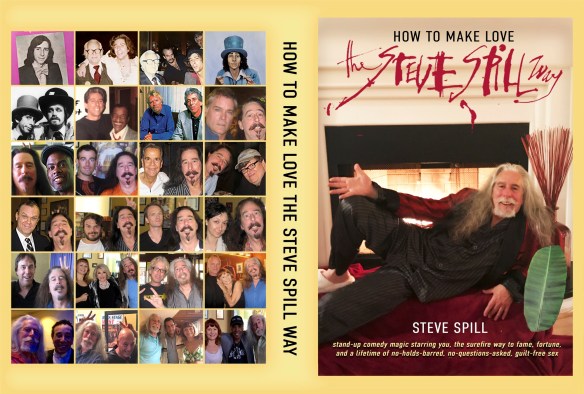
How To Make Love The Steve Spill Way

COVER_v2

***

If Lenny Bruce were a magician, he would be Steve Spill.

Lenny has long since passed onto that great big comedy stage in the sky, but fortunately our friend Steve Spill is alive and well and has come out with a new book aimed at magicians called How To Make Love The Steve Spill Way. His first book, I Lie For Money, was aimed at a general audience and contained lots of advice on how to live a creative life. It was served along with large dollops of autobiography and spit-take funny stories about the people he met along the path while building an artistic life for himself. In this new book, Steve not only continues his general advice for would-be artists, but also gives up the details of a dozen of his most creative and hilarious tricks. It would be an understatement to say that I think everyone interested in performing magic should read this book.

It’s always a great gift when a wonderful performer tips the secrets of his act, but it’s an even greater gift when the performer himself does the literate and humorous writing chore. Because it’s in that act of writing that Spill divulges his biggest secret: the most powerful thing a performer can do is to find her or his own quirkiness and unique qualities and put them out on display in a performance-oriented way.

When you read one of Spill’s books, you instantly understand what he’s talking about when he says to trust your own personality, because the pages of his books are drenched in the unique persona which he has nurtured. While on the one hand it’s instructive to pick up a Dai Vernon book written by someone like Lewis Ganson, on the other hand, the fact that Ganson, not Vernon, wrote it deprives the reader of real insight into much of Vernon’s personality. With a writer like Steve, though, it’s all hanging out there, and it’s plain as day. You understand immediately that the twelve killer presentations that Spill has detailed are perfect for Spill. Those who are not Steve would most likely fall on their faces if they did his presentations verbatim, but that’s not the point. The point is…who are you?

There are so many lessons to be learned here, not the least of which is the courage of one’s convictions. I read the beginning chapters twice, because the first time through I was laughing too much at the jokes to pay attention to the content.

But if you’ve got as warped and crazy a mind as Steve does (that’s a compliment, I think) there are bound to be doubts about whether anyone else will appreciate what you’re doing. However, Steve’s examples of himself being true to form, along with his constant brainstorming, testing, discarding, and revising of effects, serve as a model of what can be done, and act as a spur to one’s own creativity.

For each of the twelve effects Spill describes, he gives the background story on how and why he created it, and these stories are useful adjuncts to understanding how to create your own effects. The methods are tried and true, and for the most part they probably won’t surprise you with their cleverness after the fact. But that’s not what Steve is after—what will surprise and delight you is the way that Steve takes an effect from column A and a presentation from column Z, and juxtaposes them to create something never seen before, something to amuse and mystify an audience, which leaves them with the impression of a strong magical personality and experience.

What’s in the tricks section? Well it’s a compilation of Spill’s greatest hits—The Lemon thing, the Needle thing, The Himber Ring thing, the drug and hemorrhoid jokes, they’re all there, with full scripts and extra handling  and performance tips explained with loving care. The most audacious routine is one called “Abra Cadavers” which involves, well, a tale of cadavers wrapped in a personal story of tragedy. You would have to be nuts to perform it. I’m happy to report that Spill has done it many times, and tells you how to do it so that you too can be the object of abject speechless horror. I also thought that the presentation given for the UltraMental Deck was one of the best ideas for it I’ve ever come across.

At the end of the nineteenth century, the British magician David Devant expressed his appreciation of his audience with the tagline, “All Done By Kindness.” Likewise, Devant’s American contemporary, Howard Thurston, would prepare to go onstage by intoning in the wings to an imaginary audience, “Thank you, thank you for coming to my show tonight. God Bless You.” And now in the same spirit, as we navigate the twenty-first century, Steve Spill urges us to make love The Steve Spill Way. His love for magic, his love for his audiences and for his unique self are all part and parcel of How to Make Love The Steve Spill Way.


The Color of Law

color of law

***

***

Yesterday, the Arts Express radio show on WBAI FM broadcast my interview with Richard Rothstein, author of an important new book, The Color of Law: A Forgotten History of How Our Government Segregated America.

Rothstein makes a compelling case which challenges the Supreme Court’s view that nothing from a government standpoint can be done about segregation, due to segregation’s supposed de facto nature. Rothstein’s overwhelming brief charges that the construction and maintenance of segregation is in fact largely a governmental de jure set of policies, and thus demands immediate governmental remedy.

You can listen to my interview with Rothstein by clicking on the grey triangle above.

“I’ll Keep Doing It…Stubbornly”: Philip Roth

***

Author Philip Roth died yesterday. I can’t think of a novelist who has had more of an effect on me than Roth. Indeed, I don’t think I fully understood what a novel could be, and what a writer did, before I read Roth. When I am writing and I can’t figure out what to do, I ask myself WWRD–what would Roth do. The work ethic, the imagination, the dead-on ear for human speech and obfuscation, the love of language, all made him my favorite American author.

Above is an interview Roth did in 2004, where he talks about the obligations of writing. He also makes a startling prediction about the fate of novels in the near future. I hope he is wrong.

Thanks to Youtuber PBS NewsHour

Book Nook, Magic Edition (3)

magic-book-zodiac-signs-1440x900

Every once in a while I like to catch up and share the titles of conjuring books I’ve been reading, so here’s what I’ve been enjoying the last couple of months—and a little product review at the end as well:

1. Scripting Magic, Volume 2: Pete McCabe’s first volume, Scripting Magic, was one of my all-time favorite magic books. It contained scripts for dozens of excellent magic tricks, and what’s more, it told you why they were good scripts and compared them to the not-so-good examples. Anyone reading them could improve the effects they already did by following the advice in the book. Now, in Volume 2, McCabe continues with more wonderful tricks and scripts—including examples from America’s Got Talent winner Derek Hughes, and the script of Houdini’s performance of the Water Torture Cell. McCabe tells you not only what makes a good script, but also helps you to understand how to come up with a premise, and how to flesh it out. It’s terrific advice, but even if you choose to ignore it, there are some very good tricks here including “Pleasure To Burn” ( a fifty-two to one card equivoque) and the holiday-themed “Catching a Leprechaun.”  While it’s always great to learn new sleights (and McCabe teaches a few here in the context of a given effect) probably no investment of time will improve one’s magic so much as focusing on script and presentation.

2. Malini and His Magic: Dai Vernon was always humble about the debt he owed to the magicians whose work he studied, including Emil Jarrow and Nate Leipzig, but none impressed him more than Max Malini. I’ve written about Malini before, but it is hard to overestimate what an important influence he was on Vernon’s generation of magicians. In an age where magicians mainly entertained with large illusions on stage, Malini changed the paradigm. Whether he was entertaining on the stage of a large theater, a hotel ballroom, or an intimate dinner party of the rich and famous, he needed only a couple of decks of cards and some silverware to make his presence unforgettable. In Malini and His Magic, editor Lewis Ganson collated Vernon and others’ thoughts and memories of Malini in order to produce a slim but valuable volume. It starts off with some basic biographical information, and then describes the presentation and methods of Malini’s full evening show, the highlight of which was his card stabbing routine. Later chapters deal with Malini’s more informal shows, and it’s wonderful to read about how audacious his effects and methods were. Malini was also quite a self-promoter, and not a small amount of his success was his ability to “schmooze” and make friends with wealthy patrons. The one secret that remains is the famous dinner table production of a block of ice from a lady’s hat. While Vernon describes the production and one aspect of the method, he admits that he does not know how Malini loaded up. That will have to be a mystery to all but Ricky Jay, who you can see perform the astonishing trick for a skeptical journalist in the documentary film Deceptive Practice. (Hmm, I just got an idea of what may have happened.)

3. Our friend Ron Chavis is now well along with the publication of his “Official Magazine for Mentalists,” Mystic Descendant, having released a solid four quarterly issues to round out the first year. The magazine continues with its friendly, good-natured, bar-room mate outlook, and as I have mentioned before, it focuses mainly on the casual performance of mentalism, with a focus on storytelling. I’ve finally caught up with the fourth issue, and in it you’ll find a lovely true story about a seance that unexpectedly turns into a tribute to a recently deceased mentalist; a presentation of an effect that leaves warm feelings of a spectator’s meaningful relationship; and an interview with South American mentalist Mauricio Jaramillo who talks about preparing for the time when things go wrong in performance. It’s light, pleasant reading, that may well stimulate mentalism thoughts of your own; if you haven’t picked up a copy yet, you can go to http://www.lulu.com/spotlight/mysticdescendant to order any issue.

4. On some of the internet magicians’ forums, you’ll find endless discussion of what are the best cards to use, and it may seem amusing to run into spirited online discussions that go into scores of pages on whether blue-backed or red-backed cards are best to use. A lot of magicians take such things quite seriously. Anyway, much virtual ink has also been spilled about what brand of cards is most suitable for card magic. For the past few years, the product of a relative newcomer in the field, the Phoenix deck by Card-Shark, has found favor with many magicians. I like Phoenix cards a lot, but I recently became aware of the new release by the US Playing Card Company of a special edition of their Maiden Back cards. I’ve been using them for a few months now, and I really like them, maybe more than the Phoenix cards. Here’s what I think the advantages of them are:

  1. They faro out of the box very nicely. They are traditionally cut, so if you’re a top down faro person like me, you can just turn the cards face up. The cards are so amenable that I don’t mind the difference for me at all.
  2. The cards are slightly thinner than regular Bicycle stock, and seem more flexible. It makes shuffling and general handling easier.
  3. The cards fan well and keep their fanning ability even after a period of time.
  4. Each deck comes with two identical jokers, a blank card, and a DB. Good times!
  5. The cards will make fans of Boris Wild and Ted Lesley very happy, if you get my meaning, wink wink, nudge, nudge; quick, and from a distance too.
  6. The factory sealed decks are in Tamariz order. Even if you don’t know that system, what it means is that with a copy of Mnemonica to inform you (see chapter five, especially) you’ll be able to do poker routines, including any poker hand called for; bridge demos; story deck effects; and finally you can convert to stay stack and New Deck Order with some (admittedly fancy) finger flinging. All this straight out of the box. And if you do know the Tamariz system, well…
  7. The card box is subtly differentiated so that you won’t mix it up with your other decks.
  8. Penguin is selling them now for $60 a dozen, which is a totally ridiculous price for cards with the last three features. They can be your everyday decks.

So if this sounds like something you might be interested in, I’d advise you to try a brick soon, as I don’t really see how they can keep selling them at this price. Happy magishing.

Last Writes

Bury

***

So, I was having my weekly freak out about what will happen if I die tomorrow—not that I have any indication that that is going to occur—and I realized that what I was worried about the most, besides my family, was my writing.

Specifically, what about the novel that I’ve been working on for the last five years, the one that’s still sitting on my computer? My nightmare is that it just stays there with no one even knowing that it’s there. Oh, my family knows I’ve been working on it all this time—how could they not with all the agita around it?—but they don’t know what file it is, or what version is the latest, and probably they’ll have other things to think of when I drop dead, so what am I going to do? It’s strange: we finally got around to making a will, so my family is okay; but I worry about my characters. I’m worried that they will not have a chance to live. It’s a crazy feeling, but it’s a real one. I want them to have a home if they don’t find one before I’m gone. I wonder if other writers experience this. Like Pirandello’s characters, my modest creations want to have a chance to play out their stories, too.

I mean, I have been doing due diligence, sending out my manuscript and query letters, but who knows if anyone will bite? A few close calls, but still nothing. But I believe in this book and these characters, and while I know the book is not going to appeal to everyone, I say immodestly that it is good and deserves to be read by those who would enjoy it.

So I finally figured out a way to lessen my anxiety around this whole thing. I decided that I would self-publish one copy, one copy that I could leave behind, so that when I go, at least there will be some tangible evidence of what I’ve been doing these last few years. It’s kind of amazing to me the effort it takes to write a novel, good or bad. At least, the effort it took me. I don’t claim it to be anything great, but I don’t want it just to disappear.

I went onto a popular online self-publishing site, Lulu.com, having no experience at all how this was going to play out. I assumed that I would have to order a hundred or more copies to get this done. It’s not really what I wanted to do, but I figured, okay, if I have a stack of these left in my office when I kick the bucket, they can give them out at my funeral or something. When I actually went to the website, though, I was pleasantly surprised. You don’t have to order a hundred copies. You could order fifty, or fifteen, or for goodness sake, you could just order one. Yes, one’s the ticket: that’s just what I wanted. Just one to document that I was here, that somewhere in my life I did this thing, and here it is.

The whole process was not too difficult to navigate. There’s a bit of a learning curve but if you follow the directions on the website, you can create your book without too much trouble. The first thing you do is choose the format for your published book: hardbound, softbound, paper quality, different sizes, and so on. I chose a 6×9 perfect bound paperback. If you eventually decide that you want to publish the book commercially, they recommend you ask for the premium paper. This option also provides you with an ISBN number should you ever decide to go commercial with the book. Next, you download a Word template from the website and import the Word document of your manuscript into it. You then upload that file back to Lulu, and they return a pdf that shows exactly how the manuscript will look when published.

When you’re happy with what you see, then it’s time to choose a cover. There is a very easy and flexible Cover Wizard which allows you to choose from a number of attractive looking cover themes. If you like, you can add photos to your front cover; also, on the back cover, you can add an author’s photo and any text you wish. In addition, the book automatically prints with the title of the book and the author’s name on the spine. Since I am not interested right now in publishing, I did not opt for any photos or even back cover text, so I just chose an abstract cover design that I thought was attractive.

At this point you can order your masterpiece, any amount from one proof copy to hundreds. There is a discount in the price per book as the quantity goes up, but I was amazed at how inexpensive it was, even for the one proof copy I wished to purchase. For a 250 page softcover, premium paper, with a designed cover, it only cost $6, plus $5 for shipping. In other words, it cost less than a paperback at the local book store, even with shipping.

I sent off my order and the book arrived about 10 days later. It was very exciting ripping open the package, and seeing the book. It looked and felt great—it was not just a cheap knock off. It was commercial grade paper, cover, and binding. I was very pleased with that. And when I read through my book, I was ready to weep, because the story actually worked as a book. It’s one thing to read a manuscript as a file on your computer, or a collection of printed out loose papers, but when you read it as a bound book, it is a whole different experience. I kept turning the pages, and kept feeling like I had done it. Of course, what I also found were typos and pages mis-formatted, even after literally dozens and dozens of revisions. My biggest mistake was something I thought I had accurately accounted for, but I was wrong—not all of the major chapter sections and title pages started on a right hand page. But I wasn’t too worried, because the cost of re-doing a proof was cheap enough that I didn’t mind just correcting the file, re-uploading it, and ordering a new proof. That’s what I did, and ten days later I was greeted by the new corrected copy.

I have to say this whole experience really helped me to put my mind to rest. Even if you’re not as neurotic as I am, preparing to keel over at any moment, I think that if you are shopping around a manuscript you would benefit from ordering a proof copy of your work. You will see mistakes and typos in a way that you may well have missed in electronic or loose manuscript form. If you do get an agent and a publisher, wonderful; but if not, you have the option of either buying copies from Lulu and selling them yourself, or you can have the book advertised on Lulu’s website. They will do print on demand if you wish, so that they only print the number of books that are actually ordered; Lulu, of course, takes a substantial cut of the cover price that way. You also have the option of listing the book on Amazon in a similar print on demand deal, but in that case, Amazon takes such a large cut, that it hardly pays for the author.

So, if my family is reading this, now you know what that book is that’s sitting next to my will…but I sure hope you get to read it before then.

Wisdom of the Sages

meditation


Let’s say good-bye to the old year with two pensive haikus from David Bader’s Haikus for Jews:


BLT on Toast–

the rabbi takes his first bite,

then the lightening bolt.


***

The same kimono

the top geishas are wearing–

got it at Loehmann’s.


“Ze Little Grey Cells”

christie

***

***

Agatha Christie, the Queen of mystery stories, not only wrote dozens of novels, but over 150 short stories as well.  Recently, four of her short stories were read at New York’s Symphony Space, as part of the estimable radio series Selected Shorts, featuring a cast of well-known actors, and including commentary by essayist Fran Leibowitz. Click on the grey triangle above to hear my review, as broadcast yesterday on WBAI radio’s Arts Express.


Late In The Day: Constance Norgren

IMG_0811

******

I was happy to welcome back poet Constance Norgren yesterday to the Arts Express radio program on WBAI 99.5 NY to read from her latest collection of previously unpublished poems, Late In The Day. Click on the grey triangle above for some wonderful short poems.

Philip Roth’s Ship Of Fools: When She Was Good

when-she-was-good-philip-roth-first-edition-1st-printing-11f971301fcfef7cb7f9bdc1f1a6a7f3

***

Before Portnoy’s Complaint, Philip Roth had already written two very accomplished novels: Letting Go and When She was Good. I’ve previously written about my appreciation of the former novel, and When She was Good is an equally intriguing, though quite different book.

In this novel unpleasant, not one of the eight major characters, neither man nor woman, is someone with whom the reader can sympathize. It is Philip Roth’s Ship of Fools. Each character is deeply flawed, but not in the grand tragic manner—for their lives are far too small, shallow, and petty to be tragic. Their problem is that they are ordinary human beings trying to make a life, dealing the best they can with their inevitable inadequacies.

The novel, set in small town, post-war America of the nineteen-fifties, describes the life of Roy Basart, just back from the service, his future uncertain, a young man of more desire than ability. He is at that awkward age in his early twenties when he is expected to become serious, find a career, marry, and make a family. He meets and marries a young woman, Lucy Nelson, whose life has been shaped by her alcoholic father.  Lucy vows that she will never be the weak-willed woman her mother was, and that her child will have what she never had—a stable home, with a father who earns a steady living. But it is exactly her impatient and uncompromising will that leads her and all in her path to misery.

For her husband Roy is no hero, but an ordinary man with a wandering will who dreams of becoming an artistic photographer, though his head is full of cliches and other people’s ideas. His parents are strait-laced paragons of local virtue, emblematic of small town prejudice and narrow-mindedness. Lucy’s father, the ne’er-do-well alcoholic, beats Lucy’s forgiving mother, and in the defining action of the book, Lucy calls the police on her father, vowing that she will never forgive him.

Roth’s power as a writer is evident from the very beginning. His method of turning on the tape recorder and letting it run is in full effect here, as it was in his previous novel, Letting Go. Roth lets his characters talk—and talk and talk—but it is his brilliance as a writer that it is this talk that reveals everything we need to know about a character’s personality. The talk here is not just the talk between people, but the self-talk used to convince themselves. More than anything else, this book is about the power that we have for deceiving ourselves. There is not a character in the book who is not full of delusion,  misconceptions fueled and propagated by what they say to themselves. Talk, for Roth, is not so much to persuade others, but to persuade ourselves of our own goodness, and especially of the reasonableness of the compromises we’ve had to make. In Shakespeare, it takes the most brilliant evocative words and imagery to persuade others; in Roth, it only takes the most mundane and unimaginative words repeated endlessly to persuade ourselves. The cliches that fill our self-talk are what allow us to continue our self-deceptions.

Not that the characters aren’t transparently foolish to others as well. Lucy can barely contain her sarcasm at the hypocrisy and blindness of her family. She is merciless in her dissection of their faults and expects them to live up to higher standards. She demands that they exert themselves more forcefully. But in her own relentless expression of her will, she comes to disaster. In her uncompromising demand for her own way at all times, she drives away the people closest to her, including her husband and child.

Roth clearly believes that it is inhuman to expect people to live without compromises, to believe in one’s own certainty, and to demand that others live that way, too. But Roth does not let the other side off the hook either. Lucy has good reason to be disgusted at the mediocrity and slackness of others. For much of the book, Lucy seems to be the most reasonable character out of all of them. It is really only in the last part of the novel where Roth chooses sides, and then he comes down heavily against Lucy. As if the reader might miss the point, Roth, in an uncharacteristically overdetermined way, has Lucy die in a frozen patch of snow, a result of her unrelenting obsession. It’s a misstep, I think, by Roth: in real life, such situations don’t usually lead to such histrionic endings, but continue with the dull repetition of recriminations and petty bickering on both sides. It’s surprising that Roth doesn’t just allow that, after being such a faithful observer of his characters’ lives.

While the book is a tragedy of personality, it also exists within a specific social and political milieu. It contains more than a little influence of Sinclair Lewis’s 1920s Babbit and Main Street: rural and suburban America coming of age under capitalism; however, in this later work, the post-world War II context is clearly the McCarthy era with its stilted vision of success, and its strictures on what people may say to themselves and others. The unspoken subtext of the novel is the inability to achieve the American dream: the dream is a fake, shored up by anti-communism. Roy has some inklings that maybe socialism is not as bad as everyone says, but it is no more than a vague thought, ultimately just a talking point for himself, another excuse for his own personal failures.

Strikingly, this is one of the few books by Roth where Jews and Jewish culture play no obvious part. Still, in a way, it’s a parable of Old Testament judgement versus New Testament mercy. Lucy represents the vengeful willful God of the Old Testament, while her grandfather, mother, and husband lean towards the charity and forgiveness of the New Testament. They are in a sense competing strategies for survival. But both ways under American capitalism in this novel lead to tragedy. There is no way to be. Neither ruthless will, nor temperate charity, can insure happiness or survival.

Because Roth as a novelist is as uncompromising as Lucy is as a person, the book can feel pitiless. Roth refuses to turn his head away from what he sees and hears. But the skills with which the 33-year-old Roth delineated the knots of relationship is bracing in its own way. To lay it all out on the table without flinching is a powerful achievement, and left this reader, at least, more sober and in a more reflective state about his own life.

Giving the Devil His Due: Details of Deception

DOD

***

The Devil is back, and the Devil is all in the details.

The Devil, in the guise of card man Greg Chapman, has returned with a new volume of mischievous pasteboard knowledge, Details of Deception: Artifice and Entertainment with Cards. If you thought Greg’s first book, The Devil’s Staircase, was a tour de force of gambling-themed card magic ideas, you’ll be even more delighted with this follow-up. The new book can certainly stand alone as a contribution to the literature, but when seen as a companion book to its predecessor, it really makes its full impact. (Full disclosure: I gladly did some proofreading on this as well as the earlier book.)

Dai Vernon liked to quote Da Vinci, “Details make perfection, but perfection is no detail.” Vernon knew that especially in the art of magic, the difference between the right detail and the wrong detail could mean the difference between success and failure. As Teller once pointed out, magic is very binary in the sense that an effect either fools an audience or it doesn’t. There’s no “sorta” or half pregnant in magic. A slight detail can be the difference between the audience experiencing a sense of verisimilitude or not.

Greg takes on a relatively narrow slice of the magic universe and focuses sharply on the details that make a difference. As he did in his first book, Greg here first introduces the tools he will be discussing: the peek, the key card, the stack, the crimp, even the humble ribbon spread. If you think you know everything about those tools, odds are, you are in for a pleasant surprise.

Greg’s focus as he circles back to these subjects is always how to get ahead while maintaining naturalness in action and speech. To this end, Greg is all about learning how to feel comfortable in one’s habitual environment—in Greg’s case, at the card table. His style is low-key, innocent, and absolutely fooling.

The second chapter of the book introduces effects which require little to no set-up (except for, in one case, the introduction of a gaffed card). Some of them, such as “Rubaway Switch” and “OHSD Switch” are transposition effects which can also be used as utility moves. Others, such as “Any Pair” and “Card at Number,” are basically self-working tricks with a strong impact. And with just a little more faro-ing effort, “The Accomplice” and “PUnDoM” are impressive quick demos of card control.

The following two chapters are, for me, the heart of the book. In the chapter entitled Stacks, Greg goes into greater detail regarding the tools that he mentioned at the beginning of the book. There is a lengthy and invaluable discussion of estimation that opens the chapter, and I can say that for me personally, it took a skill that seemed mysterious and out of my reach, and turned it into something achievable and usable. Greg even provides outs for those times when one’s estimations are a little off. I don’t have to tell anybody who does MD work what a valuable skill estimation is to have.

Equally useful to me was Greg’s discussion of the Ribbon Spread. It really opened my eyes to the devious uses to which this ubiquitous little flourish can be put. In the sections on peeks, shiners, and deck switches, there is also much of use: not only concerning the sleight-of-hand aspects of the moves, but also the timing and body gestalt as well.

The next chapter is devoted to memorized deck routines. There is a clever ACAAN, which has some important features: the spectator can genuinely name any card, and also has a wide range of numbers from which to choose.  More importantly, the spectator can do the final countdown deal to the card. And . . . the method is essentially sleightless. Other tricks that I especially like in this section are “One Card Missing,” a snappy determination of a card missing from a deck under seemingly impossible conditions, and “That Old Trick,” a discovery of a selected four-of-a-kind that is quite enjoyable to perform, and is a painless  and safe way to practice your Mexican Turnover.

The last chapter of the book is called Second Thoughts. It is a detailed mini-treatise on how to perform Greg’s version of a push-off second. This is painstaking, nuanced work, and probably will most interest those who can’t afford the slightest inkling of suspicion. If that sounds up your alley, there are lots of diagrams, advice, and encouragement here for those who decide to tread the path. The good news for the rest of us is that Greg includes in this section an excellent gambling deal effect, “Stacked To Win,” which while requiring some quick thinking and quick second dealing, actually demands less skill than the overall impression of the effect conveys.

Greg ends the book with a wonderful Cards to Pocket that will likely fool most magicians. It incorporates a very clever, efficient gaff. I don’t know if the gaff is original to Greg, but I’ve never seen it before, and I can well imagine its use in other situations as well.

If you have any interest in improving your card magic skills, I highly recommend that you sit down to a deal with the Devil, Greg Chapman’s Details of Deception.