Bedlam: Part Two

Bedlam jacket

***

***

Last week , I posted Part One of an interview with Dr Ken Paul Rosenberg, the creator of the book and film documentary, Bedlam. He talked about the present crisis state of  mental health care in the US. This week we continue with the final part of that conversation as we talk about political considerations —-and Dr. Rosenberg’s personal stake in the story.

Click on the triangle above to hear the conversation as broadcast today on the Arts Express radio program on WBAI 99.5 FM NYC and Pacifica affiliates across the country.

Bedlam: Serious Mental Illness in America

Bedlam 5

***

***

In his new documentary film and accompanying book, Bedlam, Dr. Kenneth Paul Rosenberg, presents a moving portrait of what it means to be a person living with mental illness in America today. And in his quest to find the truth about others, he had to confront difficult aspects of his own history, and America’s history, of dealing with people diagnosed with serious mental illness.

You can hear part one of my interview with the fascinating Dr. Rosenberg, as broadcast yesterday on the Arts Express radio program on WBAI NYC and Pacifica Radio affiliates across the country, by clicking on the triangle above.

Part two is here: https://jackshalom.net/2020/04/14/bedlam-part-two/

BEDLAM will premiere on Independent Lens Monday, April 13 at 10pmET on PBS

It Must Be The Night Fever

Monday morning, you look out the window at the empty streets and think of times when the Night Fever meant something else…

Thanks to YouTuber HD Film Tributes

Time Thieves

Screenshot_2020-03-18 180717_Press-kit-TT_ENG_pages pdf

***

***

The cliché is that time is money, and it must be true because there are plenty of folks out there looking to steal our time. My guest, Cosima Dannoritzer is the writer and director of an award-winning documentary film called Time Thieves, which takes an international look at the way time has become commodified and manipulated in modern capitalist society.

Click on the triangle above to hear the interview as broadcast today on the Arts Express radio program on WBAI 99.5 FM NYC.

Trash To Gold

Gene Kelly, Michael Kidd, and Dan Duryea as three GIs about to be discharged, set out on a binge and do an incredible dance number with trash can lids. From the film, It’s Always Fair Weather, the last Gene Kelly–Stanley Donen collaboration.

Thanks to YouTuber Peggy Afuta

“I Am Spartacus”: Kirk Douglas

1902474-kirk-douglas-dans-spartacus-opengraph_1200-2

***

***

Kirk Douglas died this month. Here’s a piece I did, broadcast today on Arts Express, WBAI 99.5FM NYC, about Kirk Douglas’s finest hour.

You can listen by clicking on the triangle above.

Where Did You Learn To Dance?: Donald O’Connor and Debbie Reynolds


I was so happy to learn that the year after Singin’ in the Rain was made, O’Connor and Reynolds made another movie together (sans Gene) called I Love Melvin. Here’s a great dance number from the film.

Thanks to YouTuber warnerarchive

Get Your Arts Fix Here!

aelogo large

Woo-hoo! It’s the new monthly Arts Express Newsletter, edited by yours truly and it’s free, free, free!

Think of it as a print extension of the conversation started on our global radio arts magazine, Arts Express, heard on WBAI 99.5 FM in NYC, WBAI.org, and Pacifica affiliates across the country, in Paris, Beijing, and Berlin.

Every month, it’s eight pages of Arts Express goodness, filled with fascinating interviews, top ten film lists, reviews, gossip, film, theatre, book recommendations and more.

Here’s a preview of what’s in our inaugural February issue:

Bill+Wyman

* An extraordinary interview with Bill Wyman, the legendary guitarist for The Rolling Stones.

* Broadcast Film Critics and Women Film Critics Circle reviewer and host Prairie Miller’s Top Ten Films of 2019–and the year’s worst!

* An Arts Express Extra: Jack London’s Preface to The War of the Classes–a supplement to our recent radio performance of London’s powerful essay, “How I Became A Socialist.”

*Plus: The Guest List–our favorite recent guests; The Back Room–news and gossip about WBAI and the Arts Express crew;

*And information about exclusive giveaways and how to win an opportunity to broadcast your own work on the air.

It’s all in the new free Arts Express Newsletter.

To get your free pdf copy every month to your email address, just send an email to ArtsExpressList@gmail.com and put Subscribe in the subject line. We’ll do the rest!

220px-Portrait_photograph_of_Jack_London

Jack  London


Stevenson–Lost And Found

Stevenson Lost and Found 7

***

***

As readers of this blog know,  I’m a longtime fan of cartoons from The New Yorker magazine—and the man who wrote and illustrated almost 2000 of those cartoons was a prolific artist named James Stevenson.

But Stevenson, as Sally Williams’s new film documentary, Stevenson—Lost and Found, uncovers, led an unexpectedly complicated, rich, varied, and sometimes dark artistic life. I was happy to talk with Ms. Williams, the director and producer of the film, about her film and her enigmatic subject.

Click on the triangle above to hear the radio interview, as broadcast today on Arts Express on WBAI 99. FM NYC, and Pacifica affiliates across the country.

Up On The Air: Michael Apted

63

***

***

You may know of the great British director Michael Apted for his thrillers including the James Bond film The World is Not Enough, or you may know him for his outstanding work with Sissy Spacek in the Academy Award-nominated Coal Miner’s Daughter, or his work with Jodie Foster in Nell. But for many, Michael Apted’s greatest achievement was begun 56 years ago when he selected 14 British schoolchildren from different social and economic classes for the documentary called 7 Up. He subsequently chronicled their physical, emotional, social, and mental lives in ongoing 7-year installments. In a remarkable coup, Apted is now releasing 63 Up, and the 7-year-olds we met in 1964 are now all 63 years old.

I was lucky to interview Mr. Apted for the radio program Arts Express. Click on the triangle to hear the interview as broadcast today on WBAI 99.5 FM, NYC

Super Size Me 2–Holy Chicken

SSM2-poster

***

***

In 2004, filmmaker Morgan Spurlock ate an exclusive diet of McDonald’s food, morning, noon and night, for a month. He made a very successful movie about the effect it had on his body called Super Size Me. Now, 15 years later, Morgan Spurlock is trying his hand at chicken with a new movie called Super Size Me 2 –Holy Chicken.

I interviewed Morgan recently, and he discussed the chicken and public relations industries, and the effect of Big Agra on family farmers. Morgan also brought along two farmers to the interview, Jonathan and Zack Buttram, who spoke of their devastating personal experiences, and how they were caught up in a cycle of debt and and exploitation.

Click on the triangle above to hear the interview as broadcast today on the Arts Express radio show on WBAI 99.5 FM NYC.

The Godfather Orchestral Suite: Danish National Symphony Orchestra


***

Nino Rota’s haunting melodies from The Godfather beautifully arranged.

Thanks to YouTuber DR Koncerthuset

Woman At War

xscreen_shot_2018-05-17_at_19.51.36-1526586990.png.pagespeed.ic.M-p2kKYEod proxy.duckduckgo.com

***

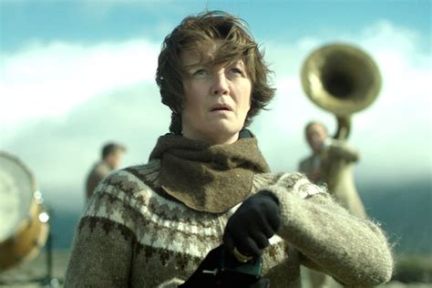
Woman At War (Kona fer í stríð) is the most thrilling film I’ve seen in a long time. It’s the story of an Icelandic woman who decides to take direct action against the new money vultures who are invading her country. The slick capitalists are bringing in their heavy industry to destroy the Icelandic environment and change the Icelandic collective way of life, so this humble woman, Halla, a choirmaster, decides to take responsibility. She drags her bow and arrow across the moss-covered Icelandic interior moonscape and shoots a line of metallic wires across the newly built, landscape-spoiling, power lines. Snap, Crackle, Pop. The lines short and knock out the power to the new aluminum plants.  The Mountain Woman has struck again.

The authorities, of course, do not take kindly to such shenanigans. They are on the lookout for this “criminal” and they use all the powers of a newly minted surveillance state. For these new capitalists, who seek to extract as much as they can from the previously clannish Icelandic village way of life, can only impose their will by enforcing it with an extensive surveillance and propaganda effort. Within hours of the power knock-out, the government apparatchiks have laid down the outlines of their counter-offensive. The Mountain Woman is immediately labelled a terrorist. The film neatly shows us how the discourse rapidly spreads from the politicians’ mouths across television, radio and locker rooms. The media buzz insists that it’s the resister and her friends, not the slick politicians who are the threat to democracy. She is falsely labelled as armed and dangerous with remarkable speed. The newly installed surveillance cameras and drones across the country make her a woman on the run, but still no less determined to accomplish her mission with the help of well-wishers and fellow travelers she meets along the way.

You can’t help but identify with the righteousness and intelligence of the woman, Halla, who gets pursued across the country. The film is constructed so that it is thrilling up to the very last moments. And in the end, in a daring and hilarious twist, our hero ends up having eluded the authorities, even as the rest of her—and our—future remains uncertain.

The acting of the lead character Halla, by Halldóra Geirharðsdóttir is a marvel. The one thing that can not be faked on a large screen is intelligence and depth of conviction.  Perhaps I have been watching the wrong movies, but I almost never see this on the American screen. Ben Kingsley achieved it in his portrayal of Gandhi, but it is very rare to find an American actor whose internal political conviction and understanding is developed enough. Perhaps this is because of the difficulty of becoming a successful artist in this country; what is rewarded and what becomes the surrounding artistic environment is one of triviality, where political affiliation is a fad of the day, more like team sports, and the propensity to actually risk one’s moral convictions  with action is nearly non-existent. But Ms. Geirharðsdóttir is not only fully convincing onscreen, you know she would be fully convincing off screen as well.

As if to counterpoint the seriousness of Ms. Geirharðsdóttir’s performance, the writer and director Benedikt Erlingsson contrasts the weighty theme with many elements of humor, not the least of which is the introduction of a character who is Halla’s twin sister—also played by Ms. Geirharðsdóttir. The portrayal of the sister is a funny, canny performance of a woman who looks inwardly towards meditation and yoga, in contrast to her twin who looks outwardly towards political action. I blinked a few times watching the two sisters together, because although they seem physically similar, their attitudes are so different that it was only with rolling of the credits that I was able to confirm that they were both played by Ms. Geirharðsdóttir.

Director Erlingsson also introduces some Brechtian-like characters who break the fourth wall, including a trio of musicians who show up at key times in the story, like a Greek Chorus. They inhabit the same space as the other characters but are unseen by them. There is also a scruffy bike-riding fellow wearing a Che Guevara T-shirt who keeps getting arrested for Halla’s crimes, but who is always let go for insufficient evidence. If you’d like to think that these characters are a commentary on the fact that when one person takes a strong moral stand and acts, there are always unseen supporters and allies, then we’re in agreement.

I was initially exhilarated by the movie, and I haven’t been able to get it out of my mind. My wife and I had spent a brief time in Iceland last year and we both enjoyed seeing locations and streets that we recognized. It brought back memories of the basically egalitarian society we found there that was on the brink of challenge from the super-capitalists.

And yet a few days later, the movie had me down. Because as thrilling as the film was, as wonderful as it was that the forces of good won out in the end, it became clear to me that the story was a fairy tale. The director puts in Brechtian elements, but forgets why Brecht did so: Brecht wanted always to point out that what was onstage at any given time was just a story, not reality. Don’t get too caught up with the characters and forget about what is really going on in the real world, says Brecht. In Brecht’s  The Threepenny Opera, this is illustrated in the most direct way possible: through a set of coincidences the hero is saved from hanging by the authorities at the very last moment with a pardon from the Queen. A happy ending. But the cast slyly declares that this is just a story, and in real life, it doesn’t happen that way. In real life, people get hanged. Don’t get too caught up in the story, says Brecht. It’s a story. A fairy tale.

But Woman At War gives no such reminders. The hero in the story gets saved over and over from perilous circumstances by sheer dumb luck. She is followed by drones, tracked by police helicopters, surveyed by cameras, followed in cars, demonized by the worst, slickest media propaganda, stripped of allies by a populace anesthetized by the inanity of  the discourse of capitalism, yet still always escapes. This is perhaps a story that is perfect for Iceland, because it is a society that is still on the precipice of the old and the new; it is a society that has worked very hard to move towards an egalitarian society, rooted in a collective memory of a people who had to rely on each other for survival. The relatively new neo-liberal vulture capital class is seeking to overturn all that. You can see the tension between these forces even in a casual visit to the country. The story, fortunately, has not been resolved in favor of the capitalists yet.

In a stroke of irony, though,  I just read that Jodi Foster has bought the rights to this film and is going to star in a re-make. She will set it in Midwest America. I have great respect for Jodi Foster, but it’s a mistake. This can only be an Icelandic movie. The forces of capital have not reached the same tipping point there as they already have here. Here in America, we are surveilled, numbered, data mined, credit checked. We are militarized, racialized, families pulverized, children incarcerated. It’s too late in America for Erin Brockovich or Karen Silkwood. Their time has passed as possibilities. Julian Assange is thrown in prison. Chelsea Manning, once pardoned, now in prison, too. And both major political parties couldn’t care less. We are way beyond the point in this country where such a fairy tale would even have meaning: even a fairy tale has to have some plausibility. We in America have lost.

Our American cinematic fairy tales now are only of force, comic book tales of being able to beat up, destroy others. The Marvel and DC Worlds. We cannot even think in any other dimension. Perhaps Iceland…

Despite my reservations, this is a great film. It will have you thinking about courage and the State and just what it is that we can do as human beings to resist the madness around us.


Woody Vs. Woody

***

Rob Brydon and Steve Coogan try to one up each other with a Woody face off in their film, The Trip.

Thanks to YouTuber DanniDK

“We Rise At Daybreak!”

***

The Pythonesque Rob Brydon and Steve Coogan one-upping each other in The Trip, killing some time in the car as they try on their figurative coats of armor.

Thanks to YouTuber AKTVUK


The Bowery Boys Meet the Monsters


Wherein Slip Mahoney (Leo Gorcey) explains to Sach (Huntz Hall) what a pasture is.

Saturday morning television memories.

Thanks to YouTuber warnerarchive

Mixed Magic

***

Legend has it that “Buster” Keaton was given his monicker by Harry Houdini after he saw the young vaudevillian Joe Keaton being knocked around and taking pratfalls in his family stage act. Keaton always had a fondness for magic, and in 1936 he did a short two-reeler called Mixed Magic. The little known film, which can be difficult to track down, had Buster playing a magician’s assistant. The movie was a talkie and made after Buster’s great silent films of the twenties.

Frankly, the movie is not very good. While watching, I was lamenting the lost comic opportunities that Buster would have taken in the early days. There he is, Buster backstage holding onto a stage curtain rope, trying to save his sweetheart up in the flies; think of the great daring, acrobatic, athletic possibilities that Buster would have taken advantage of in the golden era. But they never happen. Instead there are just anemic cutaway shots that make me shake my head. Well, to be fair, there are actually a couple of good laughs, and those interested in magic and magicians will be especially interested in the posters and apparatus depicted. So with those limitations in mind, take a look at Buster Keaton in Mixed Magic.

You can buy the complete Lost Keaton series at: https://www.amazon.com/Lost-Keaton-Sixteen-Comedy-1934-1937/dp/B003H221M8/

Al Pacino On Acting For The Stage and Screen

AARP's 2nd Annual Movies For Grownups Film Showcase - "The Humbling"

***

***

Al Pacino is one of only a handful of Hollywood actors who have regularly gone back to their roots in the theater.  At a recent press screening of his re-released films, Salome and Wilde Salome, he held forth on, among other things, the differences between acting in film and acting in the theater. Even at age 77, Pacino is a funny, enlightening, and honest speaker.

You can listen to his talk, as broadcast yesterday on the radio segment I prepared for the WBAI Arts Express radio program, by clicking on the grey triangle above.


“And Don’t Call Me Shirley”

***

Some classic clips from a film comedy that always make me laugh. I never tire of watching it.

Thanks to YouTuber ekahn92

Dealt: Fate Shuffles The Deck For Magician Richard Turner

turner

***

***

Magician Richard Turner, the fabled blind card mechanic, is the subject of a compelling new film documentary directed by Luke Korem called Dealt. I interviewed Korem who spoke about the challenges and pleasures of making the film. Though ostensibly about magic, the story is also about independence, disability, discipline, creativity, and about learning how best to play the hand that life has dealt us.

Click on the grey triangle to listen to the interview as broadcast yesterday on the Arts Express radio program on WBAI 99.5 FM..


Carpool Lane Magician: Zabrecky

***

A quirky, funny, and ultimately cryptic short film about a would-be magician who can’t seem to find his way in life.  Rob Zabrecky plays the stunted soul under the thumb of his mother. Zabrecky is a true film actor: his face, even in silence, reveals the anguish within.

Thanks to director and YouTuber Andrew Madsen Jasperson

Safety Last: Harold Lloyd

***

One of the most hair-raising sustained scenes of physical comedy ever filmed. Only Buster Keaton could rival Harold Lloyd when it came to feats of physical stamina and inventiveness on the silent screen.

Magic tie-in bonus: Lloyd was an amateur magician who once had a magic trick published in Ted Annemann’s The Jinx.

Thanks to YouTuber ict4eso

Breaking the Frame


***

After reading my friend Mitchel Cohen’s essay on factors affecting how people change their political views, I was reminded of the scene above from Chaplin’s Modern Times (I’m strange that way). Facts alone, Cohen says, are often not enough to change a person’s political views, because the person’s psychological reaction formation simply dismisses the new facts as false propaganda.

I’m a little less pessimistic concerning facts. Generally, I think that facts that challenge the framework of the conversation, or move the discussion to a wider context, some meta-level, can be very useful.

Well, this isn’t the place for that discussion (but see Mitchel Cohen’s excellent series of essays here: http://www.redballoonbooks.org/books/books.html for really deep imaginative thinking about how political change is effected and affected).

But what that conversation reminded me of was the roller skating scene from Modern Times, as well as reminding me of magic and the technology of deception. If you haven’t watched the video above yet, please take two minutes to watch it. Don’t watch the video link below though yet—it’s a spoiler.

Once you watch the first video, consider your feelings about the scene. Next click the link below.  I think you’ll enjoy it. Consider what happens to your mindset about the first video when the frame is broken.

Click here for the second video.

Thanks to YouTubers TheChaplinFilms and Petr Pechar


The Magic Sword: 1901, Robert Paul

***

A short 3 minute movie made at the birth of the new medium that so intrigued magicians and inventors alike. Robert Paul, who pioneered the invention of film in England (Edison for some reason didn’t patent his invention in Britain!), innovated cameras which allowed reverse cranking of the film stock. This allowed him to create double exposures and some of the special effects seen in the movie above.

Thanks to YouTuber shahdhaval369

Deny, Deny, Deny

***

As station politics get weirder, I can’t help feeling like the befuddled wife in this classic scene from A Guide for The Married Man with Joey Bishop, Robert Morse, and Ann Morgan Guilbert.

Thanks to YouTuber gbrady3434