The Fire This Time

fire-298105_1280

***

***

The delightful Mary Murphy as interviewer Merri Boast grills The Devil, played by me, in our original  “Sympathy For The Devil” radio satire, broadcast today on the Arts Express radio program over WBAI 99.5FM, WBAI.org ,and Pacifica affiliates across the nation.

Click on the triangle or the mp3 file link above to listen.

Bedlam: Part Two

Bedlam jacket

***

***

Last week , I posted Part One of an interview with Dr Ken Paul Rosenberg, the creator of the book and film documentary, Bedlam. He talked about the present crisis state of  mental health care in the US. This week we continue with the final part of that conversation as we talk about political considerations —-and Dr. Rosenberg’s personal stake in the story.

Click on the triangle above to hear the conversation as broadcast today on the Arts Express radio program on WBAI 99.5 FM NYC and Pacifica affiliates across the country.

Arts Express April Newsletter Preview!

April logo

And here we are with a preview of our third free issue of the Arts Express Newsletter, the jam-packed, super-duper April Issue.

As always, think of the Arts Express newsletter as a print extension of the conversation started on our global radio arts magazine, Arts Express, heard on WBAI 99.5 FM in NYC, WBAI.org, and Pacifica affiliates across the country, in Paris, Beijing, and Berlin.

Every month, it’s full color pages of Arts Express goodness, filled with fascinating interviews, reviews, scripts of our radio drama, photo features, gossip, film, theatre, book recommendations and more.

Here’s a preview of what’s in our April issue, which if you subscribe (just send an email to ArtsExpressList@gmail.com and put Subscribe in the subject line) , you will receive for free the first week in April and every month thereafter:

* Prairie Miller’s  interview with South African writer and anti-apartheid activist Tim Jenkin, who talks about his film Escape From Pretoria, which details his escape from Pretoria Maximum Security Prison, and his work setting up a communication system for the imprisoned Nelson Mandela.

*A joyful portfolio of photographs of the world’s largest flower parade held every year in Zundert, Netherlands, the birthplace of Vincent Van Gogh.

socks

* Red Vienna: An Arts Express Extra: Culture critic Dennis Broe writes about the city of Vienna in the 1920s, when a socialist city government planned and built public housing and public facilities throughout the city, which to this day makes Vienna one of the most livable cities in Europe.

* The poetry of Trinidad and Tobagoan poet Camryn Bruno, also known as “Queen Bee,” from her book Queen Bee Cavity.

queen bee (1)

*And Announcing the Arts Express Community Call-in. Would you like to join your fellow listeners in a telephone conversation about culture in a time of pandemic? Write us at artsexpresslist@gmail.com and we’ll give you more details!

*Plus: The Guest List–our recent and upcoming guests; The Back Room–news and gossip about WBAI and the Arts Express crew; and information about exclusive giveaways, and how to win an opportunity to broadcast your own work on the air.

It’s all in the new free Arts Express Newsletter.

If you’re not yet subscribed, you can get your free pdf copy every month to your email address, by sending an email to ArtsExpressList@gmail.com and put Subscribe in the subject line. We’ll do the rest!

And don’t miss our next radio show, Tuesday 3/31 at 4am NYC time, which you can hear on WBAI.org or WBAI 99.5FM NYC., featuring:

 Film: Mrs. America – Actress Margo Martindale discusses playing Bella Abzug in this upcoming feminist mini-series

TV: Asian American actress Keiko Agena on Prodigal Son, Gilmore Girls, Better Call Saul

Report From The Front: Europe And The Coronavirus. Arts Express Paris correspondent Professor Dennis Broe’s news and analysis from the European pandemic epicenter. And what all of this may have to do with austerity and automation; Shakespeare, the plague, King Lear and Macbeth; and Jonathan Swift’s A Modest Proposal – where the poor are served up as a source of nutrition and fine dining.

Plus…Pandemic radio drama, Syrian comic pandemic satire in the No Laughing Matter Comedy Corner episode – and Bernie Sanders in performance.


The Great Debate

giraffes-627031_1920
“I’m the only one on the stage who…” — Wednesday, 2/19, Joe Biden, Michael Bloomberg, Pete Buttigieg, Amy Klobachar, Bernie Sanders, Elizabeth Warren
***
(With a tip of the hat to masercot)

“I’m the only one on the stage who has mudwrestled with a ferret.”

“I’m the only on the stage who has chopped down all the trees west of the Mississippi with Babe, The Giant Blue Ox.”

“I’m the only one on the stage who doesn’t give a crap that I took three tabs of LSD ten minutes ago.”

“I’m the only on the stage who speaks nightly with Elvis.”

“What are you talking about?! I’m the guy who passed the Silly Walks Amendment.”

“I’m the only one on the stage who played Mah Jong with Barack Obama.”

“I’m the only one on the stage who isn’t on the stage.”

“I’m the only one on the stage who is wearing three jock straps.”

“I’m the only on the stage who’s wearing two clown shoes—on each foot.”

“A little girl in 1850 jumped on a train, took dead aim, and shot Jesse James. That little girl was me.”

“I’m the only one on the stage with an outty belly button.”

“I’m the only one on the stage with a dead body in my refrigerator.”

“I’m the only one on the stage lip -synching the whole debate.”

“I’m the only one on the stage who’s a graduate of the DeVry Institute.”

“I’m the only one on the stage, Chuck, who has undergone nasal irrigation.”

“I’m the only one on the stage who’s playing a kazoo.”

“I’m the only one on the stage with a banana in my ear.”

“I’m the only one on the stage who is wearing a mustache made of yak hair.”

“I’m the only one on the stage who’s speaking in Klingon.”

“Socks keep falling down whenever you limbo? I’ve got a plan for that.”

“I’m the only one on the stage who’s a Siamese twin.”

“I’m the only one on the stage who’s having open heart surgery performed on me as we speak.”

“I’m the only one on the stage who can open a bottle of Perrier with my teeth.”

“I’m the only one on the stage who can beat Donald Trump at Chinese Checkers.”

“A little girl in the year 2050, donned her jet pack and flew to the moon. That little girl was me.”

“I’m the only one on the stage who is hopping on a pogo stick.”

“I’m the only one on the stage who’s done the hokey-pokey with Martin Luther King.”

“I’m the only one on the stage who sleeps in jammies with built-in feet.”

“I’m the only one on the stage who has Borscht dribbling down his chest.”

“Let me be perfectly clear: no one should have to choose between slaughtering a porcupine and caressing a weasel.”

You Ain’t Been Doing Nothing If You Ain’t Been Called A Red

Monday morning, 96 year old Faith Petric’s song gets you out of bed.

Thanks to YouTuber wooac videos

Chomsky vs Buckley

***

This one is longish, but fun. William Buckley was a conservative who hosted a PBS show called Firing Line. He was fairly erudite, and on his show he was usually able to intellectually intimidate his debate opponents. But when he had on Noam Chomsky, Buckley was definitely outclassed, and it ‘s fun to watch the two of them parrying, with Buckley clearly in over his head. To Buckley’s credit, he allowed Chomsky onto mainstream television, something that broadcasters then and now were and are loath to do.

Thanks to YouTuber Patrick Steinkuhl


What’s Important

alcohol alcoholic bar blur

Photo by Joonas kääriäinen on Pexels.com


What’s Important? Their parties and their affairs. Their politics and their children and their schools.  Their colleges and their internships.

Their museums and their theatres and their writers and their vacations and their marriages and their infidelities; their pets and their drunkenness and their doctors.

Their beaches and their summer homes and their nameplates and their cars and their morals and their bankers and their finances and their magazines and their dresses and their jewelry and their connections. Anything else is in agreement or opposition to them.

Their music and their institutions and their candidates and their newspapers and their stocks and their bonds and their penthouses and their department stores and their linens and their towels and their privilege, their vast vast privilege.

Their intellectuals and their painters and their dealers and their playwrights and their novelists and their poetry and their foundations and their PBS and their NPR and their film festivals and their Pulitzers,  all of a piece, one big connected piece: their businesses, their Green New Deals, their social register,  their churches, their synagogues, their causes, their donations, their fashion, their unmentionables, their stories, their bodies, their color, their hair, their tuxedos.

Their television shows, their late night hosts, their pundits, their news columnists. Their op-eds and their editorials and everywhere everywhere their offices, their architecture, their downtowns, their urban renewal, their zoning boards, their free-fire zones, their armies, their wars, their front pages. Their water, their vitamins, their foot massages, their masseuses, their exercise machines, their angst, their problems, their shrinks, their gurus, their meditations. Their guns and their guards and their ocean cruises and their executive class and their private helicopters and their gold plated bathrooms and their penthouses and their literary supplements and their trust funds and their restaurants and their chefs and their poodles and their desserts and their musicals,  their sculpture, their police force, their mayor, their bribes, their musclemen, their crime and their punishment.

Their shock jocks and their PR people and their advance men and their drug dealers and their psychiatric hospitals and their doormen. Their elevator operators and their operas. Their Christmases and their bonuses. Their playgrounds and their baby carriages. Their smoothies and their lattes. Their Siri and their Echo. Their maids and their housekeepers, their butlers and their caterers,  their golf courses and their tennis courts. Their charities, their bequests, their billionaires, their philanthropies, their checks and their balances. Their lawyers and their judges, their pastors and their rabbis, their endowed chair professors and their university presidents. Their fall guys and their stooges. Their saints and their sinners. Their cocktail hours and their cigarettes. Their appetizers and their entrees, their champagne and their caviar, their perks and their lighting. Their make-up and their make-up artists, their voices and their songs.

Their money money money all over the place in every conversation, in every action, in every thought, in every deed, from getting up in the morning to puking up at night, to the sheets and the covers and the beds. Their deaths and their inheritances.

Their lives, their world.

That’s what’s important.

“How I Became A Socialist”: Jack London

800px-Jack_London_young

***

***

This month we celebrate the birthday of author Jack London, born January 12, 1876. London wrote the great nature novels Call of the Wild and White Fang, but he was also a committed socialist who wrote two volumes of essays about socialism called The War of the Classes and Revolution and other essays.

I performed a reading of London’s “How I Became A Socialist” for the Arts Express radio program. Click on the triangle above to hear it as broadcast today on WBAI 99.5 FM radio and Pacifica affiliates cross the country.


Viv And Bev At The Border

IMG_1688

IMG_2197


***

***

Vivienne and Beverly Shalom are two artist-activists who, I’m also proud to say, are my sisters. I got to sit down and talk with Viv about the weeks the two of them spent together at the Arizona/Mexico border working with various sanctuary groups. In this interview, which was broadcast on the Arts Express program on WBAI radio in NYC, Viv talks about the migrant families she met, the art projects she did with their children, going into the desert to leave water for migrants, the Scott Warren Trial, and how the experience affected her.

You can listen to the interview by clicking on the triangle above.

The song in the intro and outro is “El Hielo” by La Santa Cecilia. You can learn more about it here.


A Parent’s Confession

blur close up focus gavel

Photo by Pixabay on Pexels.com

***

Your honor, I am guilty, but consider:

At some point in every enlightened young human’s development, the following two truths become crystal clear:

1) Due to the extraordinary violence of the few, the majority are subjected to murder, torture, and unending exploitation for the benefit of those few.

2) If we are to survive as a species, humans must love their neighbors as they love themselves

For young people with a natural predisposition towards action, and an intelligence that forces them to follow premises to their logical, inevitable conclusions, the above truths can put them in the way of physical harm or worse.

For a parent, the truth must bow to the safety of the child.

Thus, I must throw sand in the face of my son’s arguments, place obstacles in the way of truth to slow him down:

“But all revolutions eventually betray the people.”
“Surely, elections make some difference.”
“How can you be sure there’s no God?”
“You realize that socialism can end up as authoritarianism.”
“Ridiculous, how many pronouns can one person have?”
“Isn’t all violence equally bad?”

My hope was that such efforts would slow him down enough to get him safely through an impulsive adolescence. To his credit, he reacted to each such suggestion with external scorn. Nevertheless, his mother and I would play our parts as parents, he his as an adolescent. Now in his mid-20s, he is less impulsive, but no less committed to the above two propositions. Fortunately, he now manages to pursue his political goals while being careful of the implications for his physical being. We are very proud of him.

Thank goodness. Sigh. Guilty, your honor.

With God On Our Side


***

In the live performance above, Dylan cuts out some verses from the studio version, but it’s such a great performance, it’s worth it.

Thanks to YouTuber Music Vault

Woman At War

xscreen_shot_2018-05-17_at_19.51.36-1526586990.png.pagespeed.ic.M-p2kKYEod proxy.duckduckgo.com

***

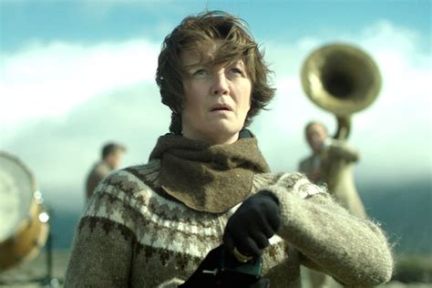
Woman At War (Kona fer í stríð) is the most thrilling film I’ve seen in a long time. It’s the story of an Icelandic woman who decides to take direct action against the new money vultures who are invading her country. The slick capitalists are bringing in their heavy industry to destroy the Icelandic environment and change the Icelandic collective way of life, so this humble woman, Halla, a choirmaster, decides to take responsibility. She drags her bow and arrow across the moss-covered Icelandic interior moonscape and shoots a line of metallic wires across the newly built, landscape-spoiling, power lines. Snap, Crackle, Pop. The lines short and knock out the power to the new aluminum plants.  The Mountain Woman has struck again.

The authorities, of course, do not take kindly to such shenanigans. They are on the lookout for this “criminal” and they use all the powers of a newly minted surveillance state. For these new capitalists, who seek to extract as much as they can from the previously clannish Icelandic village way of life, can only impose their will by enforcing it with an extensive surveillance and propaganda effort. Within hours of the power knock-out, the government apparatchiks have laid down the outlines of their counter-offensive. The Mountain Woman is immediately labelled a terrorist. The film neatly shows us how the discourse rapidly spreads from the politicians’ mouths across television, radio and locker rooms. The media buzz insists that it’s the resister and her friends, not the slick politicians who are the threat to democracy. She is falsely labelled as armed and dangerous with remarkable speed. The newly installed surveillance cameras and drones across the country make her a woman on the run, but still no less determined to accomplish her mission with the help of well-wishers and fellow travelers she meets along the way.

You can’t help but identify with the righteousness and intelligence of the woman, Halla, who gets pursued across the country. The film is constructed so that it is thrilling up to the very last moments. And in the end, in a daring and hilarious twist, our hero ends up having eluded the authorities, even as the rest of her—and our—future remains uncertain.

The acting of the lead character Halla, by Halldóra Geirharðsdóttir is a marvel. The one thing that can not be faked on a large screen is intelligence and depth of conviction.  Perhaps I have been watching the wrong movies, but I almost never see this on the American screen. Ben Kingsley achieved it in his portrayal of Gandhi, but it is very rare to find an American actor whose internal political conviction and understanding is developed enough. Perhaps this is because of the difficulty of becoming a successful artist in this country; what is rewarded and what becomes the surrounding artistic environment is one of triviality, where political affiliation is a fad of the day, more like team sports, and the propensity to actually risk one’s moral convictions  with action is nearly non-existent. But Ms. Geirharðsdóttir is not only fully convincing onscreen, you know she would be fully convincing off screen as well.

As if to counterpoint the seriousness of Ms. Geirharðsdóttir’s performance, the writer and director Benedikt Erlingsson contrasts the weighty theme with many elements of humor, not the least of which is the introduction of a character who is Halla’s twin sister—also played by Ms. Geirharðsdóttir. The portrayal of the sister is a funny, canny performance of a woman who looks inwardly towards meditation and yoga, in contrast to her twin who looks outwardly towards political action. I blinked a few times watching the two sisters together, because although they seem physically similar, their attitudes are so different that it was only with rolling of the credits that I was able to confirm that they were both played by Ms. Geirharðsdóttir.

Director Erlingsson also introduces some Brechtian-like characters who break the fourth wall, including a trio of musicians who show up at key times in the story, like a Greek Chorus. They inhabit the same space as the other characters but are unseen by them. There is also a scruffy bike-riding fellow wearing a Che Guevara T-shirt who keeps getting arrested for Halla’s crimes, but who is always let go for insufficient evidence. If you’d like to think that these characters are a commentary on the fact that when one person takes a strong moral stand and acts, there are always unseen supporters and allies, then we’re in agreement.

I was initially exhilarated by the movie, and I haven’t been able to get it out of my mind. My wife and I had spent a brief time in Iceland last year and we both enjoyed seeing locations and streets that we recognized. It brought back memories of the basically egalitarian society we found there that was on the brink of challenge from the super-capitalists.

And yet a few days later, the movie had me down. Because as thrilling as the film was, as wonderful as it was that the forces of good won out in the end, it became clear to me that the story was a fairy tale. The director puts in Brechtian elements, but forgets why Brecht did so: Brecht wanted always to point out that what was onstage at any given time was just a story, not reality. Don’t get too caught up with the characters and forget about what is really going on in the real world, says Brecht. In Brecht’s  The Threepenny Opera, this is illustrated in the most direct way possible: through a set of coincidences the hero is saved from hanging by the authorities at the very last moment with a pardon from the Queen. A happy ending. But the cast slyly declares that this is just a story, and in real life, it doesn’t happen that way. In real life, people get hanged. Don’t get too caught up in the story, says Brecht. It’s a story. A fairy tale.

But Woman At War gives no such reminders. The hero in the story gets saved over and over from perilous circumstances by sheer dumb luck. She is followed by drones, tracked by police helicopters, surveyed by cameras, followed in cars, demonized by the worst, slickest media propaganda, stripped of allies by a populace anesthetized by the inanity of  the discourse of capitalism, yet still always escapes. This is perhaps a story that is perfect for Iceland, because it is a society that is still on the precipice of the old and the new; it is a society that has worked very hard to move towards an egalitarian society, rooted in a collective memory of a people who had to rely on each other for survival. The relatively new neo-liberal vulture capital class is seeking to overturn all that. You can see the tension between these forces even in a casual visit to the country. The story, fortunately, has not been resolved in favor of the capitalists yet.

In a stroke of irony, though,  I just read that Jodi Foster has bought the rights to this film and is going to star in a re-make. She will set it in Midwest America. I have great respect for Jodi Foster, but it’s a mistake. This can only be an Icelandic movie. The forces of capital have not reached the same tipping point there as they already have here. Here in America, we are surveilled, numbered, data mined, credit checked. We are militarized, racialized, families pulverized, children incarcerated. It’s too late in America for Erin Brockovich or Karen Silkwood. Their time has passed as possibilities. Julian Assange is thrown in prison. Chelsea Manning, once pardoned, now in prison, too. And both major political parties couldn’t care less. We are way beyond the point in this country where such a fairy tale would even have meaning: even a fairy tale has to have some plausibility. We in America have lost.

Our American cinematic fairy tales now are only of force, comic book tales of being able to beat up, destroy others. The Marvel and DC Worlds. We cannot even think in any other dimension. Perhaps Iceland…

Despite my reservations, this is a great film. It will have you thinking about courage and the State and just what it is that we can do as human beings to resist the madness around us.


Home Of The Whoppers

whopper

***

The New York Times, which unapologetically lies in its pages, from Judy Miller’s Iraq stories to the current daily pro-Guaido Venezuela propaganda, from time to time deigns to run correction notices—as if to reassure its readers that the rest of the paper is copacetic. Here’s my favorite New York Times correction notice ever, from yesterday’s news story on the production of vegetarian patties for Burger King:

Correction: April 1, 2019:
An earlier version of this article misstated the kind of seeds on Whopper buns. They are sesame seeds, not poppy seeds.


Thank You, New York Times, for keeping up Standards!


Kids These Days: The Making of Millennials, Part Two

kids

***

***

Last week, I posted Part One of my interview with Malcolm Harris. Here’s how I introduced it:

“The young people tagged as Millennials have been called entitled, lazy, narcissistic, snow flakes and so on—but are those stereotypes the real deal? In his book, Kids These Days: The Making of Millennials, author Malcolm Harris investigates the political and economic forces that are squeezing and shaping his generation. In so doing, he also reveals some of the unique features of this stage of late capitalism.”

Now you can hear Part Two of my eye-opening interview with Harris as broadcast yesterday on radio station WBAI 99.5 FM NYC. The first part of the interview covered the life of millennials up to college; in this week’s Part Two, Harris focuses on the world of work, and why all of us, millennials or not, are headed in the same direction.

Click on the grey triangle above to listen.

You can listen to Part One here.

Kids These Days: The Making of Millennials, Part One

***


***

The young people tagged as Millennials have been called entitled, lazy, narcissistic, snow flakes and so on—but are those stereotypes the real deal? In his book, Kids These Days: The Making of Millennials, author Malcolm Harris investigates the political and economic forces that are squeezing and shaping his generation. In so doing, he also reveals some of the unique features of this stage of late capitalism.

You can listen to the first part of the interview I did with Harris as broadcast yesterday on Arts Express on radio station WBAI 99.5 FM NYC. Click on the grey triangle to listen.

You can listen to Part Two here.

The Great Debate

***

This parody debate of Trump vs. Sanders was done on the @midnight television show in 2016, but it looks like we may be experiencing Groundhog Day soon. James Adomian does a nice job of capturing Bernie, but Anthony Atamanuik’s Trump is uncanny. It’s way beyond Alec Baldwin’s very good impersonation; it captures something more sinister.

Thanks to YouTuber Comedy Central

Making Allowances

IMG_1804 (2)***

Bernie Sanders kicked off his campaign yesterday at Brooklyn College to a quad-filling crowd of over 10,000 people on a cold snowy day.

Best Bernie line: “I didn’t come from a family who gave me an allowance of $250,000 every year—from the time I was three years old.”

“As I recall, my allowance was twenty-five cents.”

Bedford Avenue,

Brooklyn, New York

(Un)Acceptable Losses

IMAG0923

(Click to enlarge)

Installation  at the Woodstock Byrdcliffe Guild by The Critical Art Ensemble

Woodstock, New York

“We Don’t Need No Stinkin’ Badges”

levine

***

***

In a world gone crazy, we might need to put the entire planet on the couch. Bruce Levine, a practicing clinical psychologist often at odds with the mainstream of his profession, argues in his newest book, Resisting Illegitimate Authority: A Thinking Person’s Guide to Being an Anti-Authoritarian, for the essential value of anti-authoritarians in a democracy, and questions their treatment by the medical establishment. He also dishes a few pro-tips on how resisters can survive the slings and arrows of an authoritarian society.

You can listen to my interview with Bruce Levine as broadcast this week on the Arts Express radio program on WBAI 99.5 FM NYC, by clicking on the grey triangle above.

A Child’s Garden of Denial

Photo on 10-25-18 at 10.27 PM

***

Once in a while, we here at Shalblog Industries® allow ourselves a political post. In the spirit of Shalblog Industries®’ policy of being all things to all people, however, this post will be merely descriptive rather than prescriptive.

And so…

The one incontrovertible fact about life in the United States is this: the standard of living that capitalism allows is built on the misery, torture, destruction, exploitation, and killing of millions of people around the world.

That one simple fact is really the centerpiece of our existence.

It’s a fairly impossible fact to live with.

How could we wake up every morning and function with that on our shoulders? The Shalblog Industries® Theory of American Political Ideology is simply a catalogue of the various strategies used to cope with this central fact of our existence. The style of denial a person chooses determines whether one is a conservative, fascist, neo-liberal, liberal, socialist, pacifist, anarchist, etc., or combination thereof. (And yes, certainly vice-versa is true as well—one’s political stance determines one’s denial technique.)

Why one person chooses one strategy and another person chooses another strategy is not something Shalblog Industries® is authorized to discuss right now. Our aim here is much more circumscribed. In this post we will merely catalogue the varieties of coping.

Without further ado: A Child’s Garden of Denial

1) Outright Rejection. “You’re lying. No one’s dying. At least not to make my life better.”

2) The New World Order Acceptance. “Yes it’s absolutely true–and that’s the way it must be. It’s right that people—my inferiors—should live to serve me, their superior.”

3) Life is a Game. “It’s unfortunate, but that’s life. There are winners and losers, and the losers haven’t done enough to become winners.”

4) Family Is Everything. “Life is hard enough as it is; I can’t worry about others, only myself and my family.”

5) As The World Turns. “Things will turn out all right in the end. The world is evolving slowly in the right direction. Patience.”

6) Poor Little Me. “Yes there is much injustice in the world, but I do not have the power to change things.”

7) I’m On It. “Yes, there is so much injustice in the world, and I am working to change it.”

8) It’s So Confusing. “Yes, there is so much injustice in the world, but what happens away from these shores is murky and vague to me.”

9) Not My Department. “Yes, it may be that people are not being treated well, but I’m not a political person.”

10) Pretty Please. “I see that there are injustices in the world, and if only we can get some people to be nicer, the world could be better.”

11) It Is What It Is. “This is what life is, unfortunately. No one said that life is fair.”

12) Don’t Just Do Something, Stand There. “Yes, it’s all terrible, but I have no idea what to do about it.”

13) The Beard Stroker. “Yes, it’s terrible, and if we study long enough and deeply enough to try to understand, then we can change things.”

14) God is Good.“The way things are right now is all going according to God’s will.”

15) Counter-Insurgency. “There are bad people who are spreading rumors that are just untrue. We must stop those people who are saying such things.”

16) I Gotta Be Me. “It may be true, but no one can function in everyday life with that knowledge in one’s rear-view mirror all the time.”

17) You Talkin’ To Me? “I am not the victimizer, I am the victim.”

18) The Artiste. “I’ll write a blog post about it.”


Nellie’s Updated Fixin’s

***

Monday Morning, Mckay makes mischief.

The versatile Nellie McKay, performing on The Jimmy Dore Show, updates an old Country Joe and The Fish anti-war standard. (NSFW)

Thanks to YouTuber The Jimmy Dore Show

Come The Revolution…Part Two

68400843_High-Resolution-Front-Cover_7502482-200x300

***

***

A socialist revolution in the United States in 2044? In activist Mike Albert’s new fictional journalistic account, RPS/2044, you can learn how it happened. This is the second part of the interview with Albert that I produced for the Arts Express radio program. Mike talks about what a Revolutionary Participatory Society might look like, why it’s important for present-day activists to lay out a vision for the future, and how we might get from here to there.

Click on the grey triangle above to listen.

You can listen to Part One here.

(And for local listeners to Arts Express on WBAI 99.5 FM and wbai.org be advised that Arts Express has been moved to the new edgier time slot of Tuesdays at 11pm.)

Come The Revolution…

68400843_High-Resolution-Front-Cover_7502482-200x300

***

***

It’s the year 2044, and praise to the goddesses, a socialist revolution in the United States is well in progress. How did it happen? Fortunately we have an account of the 2044 revolution in this set of oral histories that journalist Miguel Guevera has conducted with many of the heroes of the revolution. Guevera (aka 2018 activist Mike Albert) talks about the workings of a Revolutionary Participatory Society and economy in this interview I produced, broadcast yesterday for the Arts Express radio program on WBAI 99.5 FM NY.

Click on the grey triangle above to listen.

And you can hear Part Two here:

Come The Revolution…Part Two

(And for local listeners to the show, be advised that Arts Express has been moved to the new edgier time slot of Tuesdays at 11pm.)