Comrade: Jodi Dean, Part Two

JODI DEAN

***

***

Last week I posted Part One of my interview with Jodi Dean, author of the new book, Comrade. In that part of the interview, she talked about the origin and unique importance of the word, “comrade,” and how it differs from other terms like friend or ally.

This week we continue with Part Two of that conversation as we talk about what happens when comrades and party part company, and what the opening for a real politics might be in the time of pandemic. As events occur at lightening speed, her point of view becomes more important than ever.

Click on the triangle or the mp3 link above to hear the interview as broadcast today on Arts Express on WBAI NYC and Pacifica affiliates across the country.

You can listen to Part One, here.

As They Were Saying…

punctuation-marks-3038383_1280

I keep a file on my computer labeled “Quotations,” which consists of various clippings I’ve picked up along the way. Every once in a long while I like to re-read them, so I thought I’d share some of them with you.

“Every man is a damn fool for at least five minutes every day; wisdom consists in not exceeding the limit.”
― Elbert Hubbard

“The big thing about directing is to find out what gives the actor confidence. Once the actor has confidence they are free to extend themselves.”–Paul Newman

“You must never, never despair, whatever the circumstances. To hope and to act, these are our duties in misfortune. To do nothing and despair is to neglect our duty.” — Boris Pasternak, Doctor Zhivago

“My teachers should have ridden with Jessie James for all the time that they stole from me.”
–Richard Brautigan

“The closest to perfection a person ever comes is when he fills out a job application form.” — Stanley Randall

“When you feel overwhelmed, you’re trying too hard. That kind of energy does not help the other person and it does not help you. You should not be too eager to help right away. There are two things: to be and to do. Don’t think too much about to do—to be is first. To be peace. To be joy. To be happiness. And then to do joy, to do happiness—on the basis of being.So first you have to focus on the practice of being. Being fresh. Being peaceful. Being attentive. Being generous. Being compassionate. This is the basic practice. It’s like if the other person is sitting at the foot of a tree. The tree does not do anything, but the tree is fresh and alive. When you are like that tree, sending out waves of freshness, you help to calm down the suffering in the other person.” —Thích Nhất Hạnh

“It is hard enough to remember my opinions, without also remembering my reasons for them!”–Friedrich Nietzsche

“I learned long ago, never to wrestle with a pig. You get dirty, and besides, the pig likes it”
George Bernard Shaw

“Don’t tell me the moon is shining; show me the glint of light on broken glass.” –Anton Chekhov

“Creativity is not a talent. It is a way of operating.” -John Cleese

“Son, never trust a man who doesn’t drink because he’s probably a self-righteous sort, a man who thinks he knows right from wrong all the time. Some of them are good men, but in the name of goodness, they cause most of the suffering in the world. They’re the judges, the meddlers. And, son, never trust a man who drinks but refuses to get drunk. They’re usually afraid of something deep down inside, either that they’re a coward or a fool or mean and violent. You can’t trust a man who’s afraid of himself. But sometimes, son, you can trust a man who occasionally kneels before a toilet. The chances are that he is learning something about humility and his natural human foolishness, about how to survive himself. It’s ***ed hard for a man to take himself too seriously when he’s heaving his guts into a dirty toilet bowl.”― James Crumley

“Against stupidity, even the gods are invictorious.”–Friedrich Schiller


Stamped: The Remix

stamped2

***

***

In 2016 Ibram X. Kendi wrote an acclaimed book called Stamped from the Beginning, The National Book Award winning history of how racist ideas were created, spread, and deeply rooted in American society. Now that book has been adapted by Kendi and Jason Reynolds in what they call a remix for young audiences.

You can listen to my interview with Ibram Kendi and Jason Reynolds as broadcast today on the Arts Express program on WBAI 99.5FM NYC, WBAI.org, and Pacifica stations across the country by clicking on the triangle or mp3 link above to listen.

Shakespeare In A Divided America

41tW1DANdTL

***

***

It may seem as if Americans have never been more polarized than they are today. But America has always been full of splits, and Shakespeare scholar James Shapiro has written a new book, Shakespeare in a Divided America, which explores those conflicts in a unique way. He examines how Americans responded to Shakespearean productions at key times in American history, and his investigations are full of insights and surprises.

Click on the triangle above to hear my interview with James Shapiro as broadcast today on the Arts Express radio program on WBAI 99.5FM NYC, WBAI.org, and on Pacifica affiliates across the country.

The Book Nook, Magic Edition (4)

book-1291164_1280

Here’s an update on three magic books I’ve received recently, each of which I can recommend to aficionados.

First, The Top Change by Magic Christian. Christian, a seasoned performer and recognized expert on 19th century card magic history (he wrote the massive two volume work on his Viennese forerunner, J. N. Hofzinser: Non Plus Ultra) has written a monograph on the top change and its variants, illustrated with over 200 sharp black & white photographs, and includes an extensive bibliography from Denis Behr. It begins with a chapter on the history of the sleights, then gets down to basics teaching them.

The section describing the basic top change that Christian prefers is actually fairly brief—four pages of Christian’s general philosophy about the top change, and then about ten pages of photos and text  breaking down the move, step by step. Those familiar with the description of the move in Expert Card Technique or Giobbi’s Card College may be surprised by some of Christian’s recommendations. He prefers a subtle, subdued approach: he does not try to cover the move with wide sweeping arm movements, and he prefers not to move both hands.

The top change is one of those sleights which is extremely useful in card magic—Christian calls it “the most useful, the most regal sleight” in all of card magic. I have to admit that while technically it’s a much easier move than palming or doing a classic pass, I feel much more comfortable with the latter sleights than doing a top change. Like many, I am afraid of being caught out because of the boldness of the move. But I can say that with some study of the book and practice, I have been gaining in confidence, and my current efforts, as recorded on video, are not too awful. So thank you, Magic Christian.

Next up is David Regal’s new book, Interpreting Magic. It’s a big book, with the usual kind of Regal attention to close-up card and coin magic. Regal is a guy whose roots are in improv and scripting (no, not mutually exclusive at all!) and his focus is always on presenting an entertaining story and premise for his audience.  If you’ve seen any of Regal’s other books, you know he’s got literally scores of such workable effects. But curiously, my favorite part of the book was not the close-up magic, but rather the platform magic section. His imagination really lets loose with the larger effects.  He’s got very original, ingenious premises and presentations with props that are more unexpected and amusing than the usual card or coin routines. Also, scattered throughout the book, he has some great interviews and essays. There’s not a whole lot of organization to this huge book, so at 500+ pages it’s a bit of a hodge-podge, but I really like dipping into it at random. Definitely recommended.

And finally, there’s Thinking Of You, the latest annual offering from Andy of the magic website, The Jerx.  The previous book from The Jerx, Magic for Young Lovers, was one of my all-time favorite magic books. The current book is also quite good, though unsurprisingly, not in the same league as its predecessor.  MFYL set a high bar to reach and Andy seems to be aware of that. While the earlier book was conceived as a whole philosophy and approach to amateur magic—and largely succeeded—this one is much more modest in its aims. Thinking Of You is mainly concerned with the performance of mentalism in an amateur social context, and as such it’s more of a toolkit—okay, a bag of tricks—rather than some overarching vision, despite some valuable advice on how to approach social mentalism. That said, many of the individual ideas and effects are quite strong and without the comparison to the other book, it’s quite a respectable piece of work. The book is physically similar to the last two Jerx books, though there are no illustrated endpages as the previous books had. However, for those complaining about the high price of subscribing to the site and receiving the book, here’s a hot tip: some of the best ideas and effects in the book are already on the Jerx site for free, if you comb through the site. Either way, Andy has a ton of great advice for those performing in an amateur social context.

And upcoming: the gambling subset of magic fans has been eagerly awaiting Steve Forte’s new double volume opus on gambling sleights i.e. false deals, shuffles, switches, and so on. It’s Forte’s name that’s the draw here, as his status as a card worker is legendary, and his knowledge and invention of gambling sleights is second to none. In any reasoned list of the best living card workers, Forte’s name is probably going to be right at the top. Forte printed up a first run of 1000 copies, and by the time you read this, it probably will be all sold out, despite the fact that it won’t even be published for another few weeks. A special section on Erdnase’s Expert At The Card Table in the book promises to be a paradigm-breaking re-imagining of the old master. It will be interesting to see if Forte’s book, called Gambling Sleight of Hand, lives up to its high expectations.

All of the books are very good. Depending on your taste in magic, at least one of these books will make a worthwhile read for you.

It’s The Thought That Counts: Simon Aronson, An Appreciation

***

I read the news today, oh boy.

Simon Aronson died this past week.

He was one of the most brilliant and clever creators of card magic effects of the past 50 years. His methods were… shall we say?…memorable. The house of magic is large, as Eugene Burger was fond of saying, and Simon’s creations fit a particular room. His magic was brainy, intellectual, and absolutely fooling. There are magicians who are great at fooling laypeople; there are magicians who are devious enough to fool other magicians; but the amazing thing about Simon’s card magic is that if you were doing it, it would fool even yourself. To this day, there are probably legions of magicians who perform his “Shuffle-Bored” or “Prior Commitment,” and who still have absolutely no idea why they work. What they know is that they do work, and they blow the minds of people who see them. If the performers themselves can’t figure them out, you can imagine, then, that the spectators have got zero chance. (If you like, we can discuss in the comments about your personal favorite effects of his.)

But make no mistake, Simon’s tricks impressed non-magicians as well. There’s a funny story that magician John Bannon tells in his introduction to one of Aronson’s books. He shows the secretary of Simon’s law firm a card trick, hoping to impress her, and she only smiles pleasantly. Then she says with wide open eyes, “But have you seen Simon’s card magic?”

Speaking of Aronson’s books, I doubt there has ever been a more meticulous, detailed magic writer than he was.  His books—Bound To Please, The Aronson Approach, Simply Simon, Try The Impossible, and Art Decko—are masterpieces of explanation of intricate methods. While Simon was not above using sleights and gaffs in his magic (and he delighted in upsetting fellow magicians’ expectations of what his bag of methods might include) his claim to fame really rests on thinking very hard about a few tools which required mostly sleight of mind. As he would say, just as you have to plan things so that your sleight of hand doesn’t show, you also have to plan effects so that your sleight of mind doesn’t show either. In Simon’s books, he takes you through all his thinking point by point, thoroughly exploring variations and improvements, telling you what versions he threw out as weak or too revealing, giving you his scripting, and moreover, unlocking the reasons why his methods work. Simon’s training as a lawyer shows—his books are not just explanations, but  thorough briefs with points and subpoints. In magic circles people like to debate, with near religious ferocity, whether it’s better to learn magic from books or DVDs. Of course both sides have valid views, but for the book-lovers, their strongest argument is two words: Simon Aronson.

No one would call Simon an extraordinary performer, but on occasion he would step away from the card table to do another kind of magic: his mentalism act that he created with his college sweetheart and wife of many years, Ginny. (There’s a great photo of college-aged Simon and Ginny on the Jerx website that speaks volumes about them. And Bill Mullins on the Genii Forum posted a wonderful remembrance from Simon about his father who was very active in the 60s Civil Rights movement). They did a classic two-person mindreading act, and fortunately it was captured on video as an extra on one of his videos. It’s something that neither he nor Ginny have ever revealed, and while clearly there must be some code going on, I have resigned myself to the fact that if Simon created it, I’m never going to be able to figure it out. You can see their act for yourself in the L&L video I posted above.

At the first run of mentalist Derren Brown’s Secret here in NYC, Derren pointed to a man in the audience to volunteer for the next effect. It was dark in the theater so I couldn’t see that well, but I thought the man looked familiar; then he said his name was Simon and the woman sitting next to him was Ginny…

I made sure to “accidentally” bump into him as the theater was emptying, and nervously introduced myself to him. He was so nice—he said he knew my name from this blog, and then proceeded to describe the photo I have on the title page of it! I got to talk with him a little longer as we walked together in the rainy weather, and found them a cab back to their hotel. Really couldn’t be nicer people. I treasured that comment from him, as one of the very first essays I wrote on this blog was inspired by an essay of his.

Simon Aronson was a full-out, full-deck memorable mensch, and I’m sorry to hear about his passing. From the Jack of Spades to the Nine of Diamonds, he will not be forgotten.


Stevenson–Lost And Found

Stevenson Lost and Found 7

***

***

As readers of this blog know,  I’m a longtime fan of cartoons from The New Yorker magazine—and the man who wrote and illustrated almost 2000 of those cartoons was a prolific artist named James Stevenson.

But Stevenson, as Sally Williams’s new film documentary, Stevenson—Lost and Found, uncovers, led an unexpectedly complicated, rich, varied, and sometimes dark artistic life. I was happy to talk with Ms. Williams, the director and producer of the film, about her film and her enigmatic subject.

Click on the triangle above to hear the radio interview, as broadcast today on Arts Express on WBAI 99. FM NYC, and Pacifica affiliates across the country.

Magic Magazine Junkie

IMAG1757

***

I’m a magazine junkie, but unfortunately, for a variety of reasons, magazines are fast becoming a thing of the past. It’s a precarious business. And magic magazines historically have been even more precarious than most other categories of periodicals. It’s not unusual at all for a magic magazine, first announced with the boldest of intentions and good will at the beginning not to make it through even a year. The subsequent cancelling of subscriptions, unreturned money, late and missing issues are the stuff of legend and also often enduring acrimony in the magic world.

And yet new magic periodicals are announced all the time, and folks plunk down their dollars, hoping to get their latest magic fix in measured doses. But to a true magazine junkie, there’s nothing sweeter than pulling down a bound volume of ancient magic magazines from days past and thumbing through it. There’s a saying that if you want to hide the secret of a magic trick, write about it in a book. My corollary to that is if you want to fool the book readers, do something from a magazine. That’s where you’ll find your really obscure effects.

But the pleasure of reading the old magazines is not just to find another magic trick, but to get a sense of the smell and taste of the time, the ads, the news of who was playing in what theater, which dealers were pushing which effects, what the in-group gossip and backbiting was, but most gratifyingly, the imprint of the editor. Because really that is the most important factor in my enjoyment. I love a rag with a voice, an opinion, a personality, a sensibility, even if it’s not one I share with the editor.

Here is a list of five of my favorite classic magic magazines of the past, all of which can be found in bound volumes.

The Sphinx has had a long, long publication history. It ran from 1902-1953,  quite a feat in a field where it’s often a wonder when a publication makes it to issue #2.  I’ve written a series of posts about this magazine, but even that only scratches the surface in describing its wonderfulness. It is filled to the brim with great stage magic, photographs, and feature articles on famous magicians of the day. The complete print run costs thousands, but the entire number is available on CD for a ridiculously low price.

The Jinx was the newsletter started by Ted Annemann, which ran from 1934 to Annemann’s suicide in 1942. The magazine’s name was a play on its predecessor, The Sphinx. Annemann was a clever inventor of tricks who preferred subtlety over sleights: unlike The Sphinx which focused more on stage and apparatus magic, The Jinx was oriented more to close-up and parlor magic. The Jinx specialized in particular in mental magic, and the bible of mental magic, Annemann’s book Practical Mental Effects, was drawn from effects first printed in The Jinx. Annemann’s honest editorials in every issue managed to offend many, but his observations were often quite sharp.

The Phoenix, which ran from 1942 to 1954, was writer Bruce Elliott’s tribute to Ted Annemann’s The Jinx. In format it was much the same: a newsletter every two weeks or so with some featured tricks and then a column of observations by the editor. Elliott had more outside interests than Annemann, which gave it a bit of a more varied texture than The Jinx. There were lots of contributions from the great names of the day, including Paul Curry, Dai Vernon, Ed Marlo. Like Annemann’s periodical, Elliott’s taste ran to the kind of thing you could show to the boys after the poker game without too much practice. The first Phoenix volume was the first I ever bought from Tannen’s as a youngster, and it holds a special place in my affection. Elliott gave it up in 1954 after 300 issues, and it was succeeded by The New Phoenix for 100 issues with different editors. The magic content of the periodical remained high, but without Bruce Elliott’s savvy Back Room columns, I didn’t find it as enjoyable a read.

Hugard’s Magic Monthly had a run from 1943-1964, basically contemporaneous with the two Phoenix publications, but it had a very different flavor about it. The individual issues had a higher page count, and in its stride it had a number of regular columns and features by contributors in each issue. There were regular book reviews, listings of the latest stage shows, excerpts from books,  and historical features. Although it was printed on newsprint like The Jinx and The Phoenix, and illustrated mainly by line drawings, it had a larger sense of worldliness than those two publications. Because Jean Hugard and Milbourne Christopher, the two main editors and often pseudonymous contributors, had extensive experience in stage magic and the world of show business, their magazine combined the more professional, international feel of The Sphinx with the  magic clubbiness of the other two periodicals.

Apocalypse was a monthly magazine put out by Harry Lorayne from 1978 to 1997. Richard Kaufman, the current editor of Genii magazine, started it with Lorayne when he was a young man, but by its second year, Lorayne was the sole editor. The magazine featured close-up magic effects from the top magicians of the time, with many contributions from Lorayne himself in the field of card and coin magic. Lorayne was a tireless self-promoter and writer, and managed to get great material from his contributors. Lorayne also always provided yearly trick and author indices with each volume, a welcome addition, especially in a day and age before digital searches were possible. Harry famously would include his “Afterthoughts” to many effects including his own, which were short paragraphs of variations and additions to a given effect, sometimes useful, sometimes not. While there’s no doubt that Harry had (and still has in his 90s) a distinctive voice and take on magic, for many, including myself, his narcissism and pettiness make it hard to enjoy the more newsy items he reported on. Still, the magic contained within (check out all the great contributions by David Regal over the years) make this a nominee for desert island reading.

Some of my other past favorite periodicals were Karl Fulves’s publications: Chronicles, Pallbearer’s Review, and Epilogue, though they don’t have the voice or editorial content that the others mentioned above have. Another favorite of mine, too, is Steve Hobb’s more recent periodical Labyrinth. It, also, has little editorial content but contains lots of very clever card magic and sleights.

And, finally, if you don’t find something appealing here, you might take a look at this list of magic periodicals:

https://geniimagazine.com/wiki/index.php?title=Magic_Periodicals

Magicpedia estimates there have been over a thousand different magic periodical publications since 1895. So magic magazine junkies take heart—you have plenty of choices to keep you busy for a very long time.


+

Fifth Anniversary: Favorite Posts Of The Last Year

black and brown long coated dog birthday

Photo by Natasha Fernandez on Pexels.com

***

Yesterday, I put a wrap on the fifth year of this blog (put your favorite emoji here), and in keeping with my annual tradition, here are 25 of my favorite posts of the past year created by the Shalblog Industries® team. In no particular order:

A Child’s Garden of Denial

Three Secrets

Letter To A Principal

I Dream of Genii…

Permanent Record: Edward Snowden

Three Poems

Where Eagles Dare

Coriolanus: The Nihilism of War

“…Followed By The Pound Sign…”

Online Ordering

“I Would . . . Prefer . . . Not To . . .”

Woman At War

Two Schools of Magic

Federico Garcia Lorca And The Duende

You Don’t Look A Day Over 450

How To Produce Interviews For Radio And Podcast

Whoa, Nellie!

Kids These Days: The Making of Millennials, Part One

“Hard Luck”: Sholom Aleichem

The Road Not Taken

The Five Boons of Life

A Hole In The Fabric Of Time And Space

“They All Want To Play Hamlet”

Gerald Deutsch’s Perverse Magic: The First Sixteen Years

“We Don’t Need No Stinkin’ Badges”

Thanks for an enjoyable year and all your comments and support so far!

Contest Update

bookcase bookshelves chairs empty

Photo by Ingo Joseph on Pexels.com


I came home after four days of being away and The Horror, The Horror!

Whole shelves of my magic items were completely empty.

“Stop, thief!” I cried. “Someone’s stolen my very best magic books, DVDs and tricks.”

Just then my wife appeared. “Jack, stop having a cow. Everything’s all right. You’re having a magic contest, right?”

“Uh, yes,” I said confused.

“Well, I know how much you respect the readers of your blog, so I put the best stuff aside for your contest.”

“But, but, but…” I stuttered. “That’s my favorite…best…”

“No complaining. I’ve got your prize grab bag set up for you. And who knows there may be even more to come. Now tell everyone to enter soon, timeliness counts and the contest is ending soon. And make sure you tell them that they can find out all the details here:

https://jackshalom.net/2019/09/29/the-fifth-annual-shalom-blog-magic-contest/

Anyone can enter. See, I’ve done you a great favor.”

I nodded half giddy, as I went through the list. Bye, bye, favorite magic items, it’s been good to know ye.

The contest magic prize grab bag includes:

Books

Milo & Roger
The Vernon Touch
Blomberg Laboratories
The Collected Almanac

John Luka’s L.I.N.T
Korem Without Limits

Tricks and DVDs

Charlie Justice’s Prohibition
Sanders’ Tagged
Jon Allen’s The Vanishing
Duvivier’s Magic Vol 3
Striving’s Sight Unseen Case
Scott Alexander’s The Needles
Peter Eggink’s Phantom

with more to come!

Enter now at https://jackshalom.net/2019/09/29/the-fifth-annual-shalom-blog-magic-contest/

On The Road: Jack Kerouac

***

Kerouac reads from his seminal Beat novel on The Steve Allen Show, while Steve provides backup. This is the only known film of Kerouac reading his own work.

Thanks to YouTuber Historic Films Stock Footage Archive

Kids These Days: The Making of Millennials, Part Two

kids

***

***

Last week, I posted Part One of my interview with Malcolm Harris. Here’s how I introduced it:

“The young people tagged as Millennials have been called entitled, lazy, narcissistic, snow flakes and so on—but are those stereotypes the real deal? In his book, Kids These Days: The Making of Millennials, author Malcolm Harris investigates the political and economic forces that are squeezing and shaping his generation. In so doing, he also reveals some of the unique features of this stage of late capitalism.”

Now you can hear Part Two of my eye-opening interview with Harris as broadcast yesterday on radio station WBAI 99.5 FM NYC. The first part of the interview covered the life of millennials up to college; in this week’s Part Two, Harris focuses on the world of work, and why all of us, millennials or not, are headed in the same direction.

Click on the grey triangle above to listen.

You can listen to Part One here.

Kids These Days: The Making of Millennials, Part One

***


***

The young people tagged as Millennials have been called entitled, lazy, narcissistic, snow flakes and so on—but are those stereotypes the real deal? In his book, Kids These Days: The Making of Millennials, author Malcolm Harris investigates the political and economic forces that are squeezing and shaping his generation. In so doing, he also reveals some of the unique features of this stage of late capitalism.

You can listen to the first part of the interview I did with Harris as broadcast yesterday on Arts Express on radio station WBAI 99.5 FM NYC. Click on the grey triangle to listen.

You can listen to Part Two here.

Little Women: Lynda Barry

little women

More Lynda Barry at https://www.drawnandquarterly.com/author/lynda-barry

and

http://www.adambaumgoldgallery.com/

“A Wise Word…” Sholom Aleichem

sholom-aleichem-author-photo-2

***

I’ve been working on a radio project about the Russian humorist and storyteller, Sholom Aleichem, and while researching his life, I came across some quotes of his that you may enjoy. Like Mark Twain, George Bernard Shaw, and Oscar Wilde, there are so many quotable writings, that the problem becomes limiting oneself to only a few. Here are some of my favorites.


* “And books — she swallows like dumplings.”


* “While I kept playing chess with him, his mind was elsewhere. I took his queen and he took my Rose.”


* Life is a dream for the wise, a game for the fool, a comedy for the rich, a tragedy for the poor.


* The rich swell up with pride, the poor from hunger.


* When you die, others who think they know you, will concoct things about you… Better pick up a pen and write it yourself, for you know yourself best.


* No matter how bad things get you got to go on living, even if it kills you.


* A bachelor is a man who comes to work each morning from a different direction.


* If somebody tells you that you have ears like a donkey, pay no attention. But if two people tell you so, buy yourself a saddle.


* This is an ugly and mean world, and only to spite it we mustn’t weep. If you want to know, this is the constant source of my good spirit, of my humor. Not to cry, out of spite, only to laugh out of spite, only to laugh.


* A wise word is not a substitute for a piece of herring.


***


With thanks to the following websites:

https://www.brainyquote.com/authors/sholom_aleichem

https://www.goodreads.com/author/quotes/18362.Sholom_Aleichem

https://www.azquotes.com/author/210-Sholom_Aleichem


Writers Under Surveillance

police blue sky security surveillance

Photo by PhotoMIX Ltd. on Pexels.com

***

***

What did Ray Bradbury, James Baldwin, Susan Sontag, Ernest Hemingway, and Hannah Arendt all have in common? They were all victims of FBI surveillance under J. Edgar Hoover. You can listen to my radio interview, which ran yesterday on Arts Express WBAI 99.5 FM NYC, with J. Pat Brown, editor of Writers Under Surveillance, a collection of FBI files obtained through the Freedom Of Information Act, by clicking on the grey triangle above.

Three Magic Biographies

 jarrettvernonmilo

Recently, I’ve been enjoying reading a few magic biographies. All three books are highly recommended, and any one of them would make a nice gift for that magic aficionado in your life.

1) “If there was any doubt that Guy Jarrett was nuts, it ended in 1936.” That’s how magic inventor and writer Jim Steinmeyer in Jarrett introduces the cantankerous illusionist, author of the eponymous  Jarrett, Magic and Stagecraft, Technical. It’s not hard to see why Jim Steinmeyer was drawn to write about Jarrett. Jarrett was not just a magician but, like Steinmeyer, a stage illusion inventor of extraordinary ingenuity. Couple that with Jarrett’s eccentric life, acerbic wit, and amusing public persona and you have the kind of subject that an author loves to write about.

Jarrett enjoyed publicly trashing the magic royalty of the day. Houdini, Goldin, Thurston, —none of them were off limits. With the introduction and annotations by Steinmeyer, it soon becomes apparent that Jarrett’s curse and glory was his perfectionism. To Jarrett’s mind, the shaving of a few inches off the side of a production cabinet or table was the difference between beauty and illusion on the one hand, and utter crap on the other. Practicality and budget were excuses to him, and as far as Jarrett was concerned most of the illusionists of the day like Thurston were satisfied to settle on crap.

As befits a man who spoke his mind so openly and contemptuously, Jarrett didn’t retain a wide circle of friends. With his characteristic self-sufficiency, Jarrett published his book himself, setting all the type himself on a foundry typesetting press, pretty much as Gutenberg had done centuries before.

But the eccentric Jarrett (my favorite photo in the book is Jarrett at 74 years old standing upside down in the top of a tree) according to Steinmeyer was the real deal when it came to designing illusions. Jarrett’s efficient descriptions and drawings of such illusions as “The 21 Person Cabinet” and the disappearance of Bela Lugosi in the original Broadway production of Dracula make for entertaining reading and broadened my appreciation of illusion design.

2) Dai Vernon: A Biography, by David Ben, is the authorized biography  of the man who revolutionized the study and performance of close-up magic. and it draws upon many previously unseen original sources. It has some wonderful photos, including the famous one, repeated many years later, of Vernon, cigarette in hand, staring down at the Ace of Clubs. Ben’s prose is pretty pedestrian, but it gives a fully rounded picture of the man and his times. What one really gets from this portrait of Vernon is just how tenaciously Vernon strove to carve out his own artistic path. As an art student at the Art Students’ League an artist he met told him that continuing in art school would ruin him for creativity and originality. Vernon took that to heart and never allowed himself to swerve from a life that would allow him the freedom to explore and play to his heart’s content.  Many times he could have traded on his skill and connections to become famous with the general public, but at each turn he almost compulsively avoided or sabotaged those opportunities in favor of living a Bohemian lifestyle, free from the hard spotlight of fame and stultifying routine. He was a brilliant ne’er-do-well who was terrified of being tied down to any responsibility but his art.

Another wonderful revelation in the book is the portrait of his wife, Jeannie. She was a Coney Island magician’s assistant, full of practical knowledge and no mean slouch either when it came to art. She was a very creative person in her own right, an accomplished costumer and mask maker (there’s a wonderful photo of her beautifully lifelike mask of Cardini) and she was essential in costuming Vernon’s Harlequin turn. She understood her own predicament in being the creative spouse of another more talented and obsessive creative person. Once she had left Vernon she wrote her own account of what it was like to live with him in her manuscript, I Married Mr. Magic, or Laughter is the Only Shield.

This volume, the first of two, only covers the years 1894-1941, when Vernon had the construction accident which was to break his arms and change his life. Unfortunately, there is no word on Ben’s website as to when Volume II is expected (it’s been over a decade now), so we’ll have to be patient. But surely, that too promises to be fascinating, as it will cover the Magic Castle years to Vernon’s death. This is a compelling portrait of genius at work and play.

3) Milo and Roger: A Magical Life is the title of Arthur Brandon’s autobiographical account of his childhood, and his longtime partnership with Roger Coker as the comedy magic team Milo and Roger. If there is a sweeter and funnier account of one’s magical journey, I don’t know of it. Brandon devotes a lot of the book to his Norman Rockwell upbringing in small town Ohio, and he vividly brings to life the characters, the grifters, and the tradespeople who inhabited his childhood world. His parents—his mother in particular—were lovable eccentrics who were accepting and encouraging of their moony son’s infatuation with all things magical. Brandon goes on to small time fame by following his instinct and love for magic, meeting along the way his lifelong partner Roger who complements everything Arthur does. They travel the world together, much of the time only a few dollars short of broke, but somehow they always make it out to their next adventure, spurred on by their love for show business and magic. At turns nostalgic, laugh-out-loud funny, sweet, sour, and sad, this is one of the most entertaining show business autobiographies I’ve read. I can well understand why this is a favorite of many.


Fourth Annual Contest Results!

art backlit dark dawn

Photo by Matheus Bertelli on Pexels.com


A big thanks to everyone who participated in the contest. It was really enjoyable reading the entries. The assignment was to elucidate what you considered the three greatest tricks in Our Magic.

At first, I wasn’t exactly sure what my criteria was going to be in judging the entries, but as I was reading them, it soon became clear that the best ones were the ones whose descriptions were so compelling that they made me say to myself, “Hey, that’s a trick that I want to go out and perform right now.”

The first-prize winner was Sean-Dylan Riedweg whose entry described exactly why he thought each of the three tricks he nominated were winners, and he also provided meticulous citations for each effect. Sean-Dylan chose Semi-Automatic Card Tricks Vol III by Steve Beam as his prize.

The second-prize winner was Abe Carnow. Abe made a very strong case for a trick which most of us have in our drawers, but disdain to use during performance. Sometimes we forget how good some of the most common ideas in magic are. He  chose Stewart James: The First Fifty Years as his prize. We advise Mr. Carnow to get into good physical shape with a few bench presses before attempting to lift that weighty tome.

Third Prize went to Steven Go. Steven also advocated for a trick that most would consider very commonplace, but Steven provided a very wonderful description of the effect of the trick on his young daughter. He really brought to life what a special moment was created between the two of them because of that trick. He chose the DVD Time is Money by Asi Wind as his prize.

And finally Honorable Mention to Steven Bryant for his incredible poetic entry, which was part of an even larger Magic Castle New Year’s magical poetic ode.

Thanks again to all who entered. Sometime next week, everyone who participated will receive a pdf compilation of all the entries that were sent in.

Okay, rest up and if there’s enough demand, we’ll do this again next year.


Book Nook (6)

pile of books

Photo by Pixabay on Pexels.com

***

For the past decade or more, my reading habits have been very cyclical: for months at a time, I can’t seem to pick up a book, and then all of a sudden, something will kick in and I’m reading a lot. So, since it’s been a while since I’ve done a non-magic edition of Book Nook, here are some of the books I’ve enjoyed reading lately:

Government by B. Traven

This is the first of the mysterious B. Traven’s Mexican “Jungle novels” a sharply provocative and humorous set of novels set in Mexico just before the Mexican Revolution in the early 1900s. This initial book is a masterpiece of dry humor and wry observation. It’s major subject is the petty and not-so-petty corruption of government officials at every level of society. But Traven makes clear that the corruption of the local officials in their drive to exploit every peso and drop of sweat out of the local Indian population is just a reflection of the larger overall exploitative capitalist system happening on the national level. The author pulls no punches and names things for what they are. It’s a system where friends and family catapult you into power, but you must always watch your back or you’ll get stabbed by one of them. The parallels to today couldn’t be more apt or timely. This is a book that shows you the blueprint. Especially remarkable as well is a contrasting passage where Traven describes how the tribe of local Indians choose their leaders democratically, in a way that ascribes grave responsibility and accountability to the chosen one.

***

Clock Dance by Anne Tyler

I enjoy Anne Tyler’s novels because when reading her books, I get the sense that she is in no hurry.  She’s a writer who knows that after this one’s finished she’s going to write another one, and the current one is a wave in the larger ocean of her work. She doesn’t feel that she has to put everything she knows in one book. So this story is a small one of a woman’s life viewed at several milestone years. Externally, not a lot happens. But we see how a child of promise slowly has her options closed off as life proceeds and what it might take to find some sense of freedom in the end. Tyler’s characters always feel real enough so that you feel a sense of loss when a book is over, loss for the people who you have met in the course of reading the novel.

***

Radical Walking Tours of New York City by Bruce Kayton

It’s rare that one can read a guide book straight through like a work of fiction, but Radical Walking Tours of NYC is one such book. It takes us on over a dozen walking tours of several neighborhoods of NYC, and vividly depicts the rich labor and political history of this city which has been home and host to so many great figures and stories. Along the way you’ll learn a lot about history they never told you about in school. Whether it’s the location of Allen Ginsberg’s apartment or Emma Goldman’s massage parlor, you’re sure to find out something new here. Bruce Kayton is well qualified for the task as he for many years led such tours through the city.

***

The Untold Stories of Broadway by Jennifer Ashley Tepper

Years ago, Mary Henderson wrote a seminal work on the history of New York City Theater buildings, The City and the Theater, and now Jennifer Ashley Tepper has come out with an oral history of the people who worked and performed in those buildings in The Untold Stories of Broadway.  The multi-volumed series is organized by theater building, and in each chapter the people who worked in each theater on various productions tell what it was like to be part of that experience. The author has interviewed scores of people. The work is valuable in the 360-degree view that the book gives you of theatrical production. So, for example, in a chapter on the Shubert Theatre, you not only get the point of view of the actors who worked on such shows as Spamalot, Rent, and A Chorus Line,  but you also get commentary from the house manager and even the concession stand operators. You’ll also learn a lot about the physical layout of each theatre, and why some theaters are suitable for one kind of show, while other buildings are better for other kinds.These stories are not necessarily juicy remembrances of gossip, but honest, workaday accounts of people’s experiences from the inside. Many books purport to give a “backstage” view–this one really does it. Highly recommended for Broadway Babies.

***

A Walk in the Woods by Bill Bryson

For years, my friend Tom has been trying to get me to read Bill Bryson’s books, and now I finally understand why he is such a fan. Bryson is a very entertaining writer and this account of his attempt to walk the Appalachian trail is a fun read. A gentle humorist in the vein of Dave Barry, Bryson takes you along his sometimes grueling hike, and introduces you to a wonderful set of characters, both those who join him to walk the trail, like his unprepared but faithful companion Katz, and the variety of hikers he meets along the way. Bryson is funny, but he also succeeds at communicating the awe-inspiring nature of the path, and the sheer doggedness and courage it takes to accomplish completing the trail. At times, the tale proves unexpectedly touching. For myself, I was very happy to sit in my easy chair and nod my head saying to myself, “Yup, that’s why I’m sitting here.”

Come The Revolution…Part Two

68400843_High-Resolution-Front-Cover_7502482-200x300

***

***

A socialist revolution in the United States in 2044? In activist Mike Albert’s new fictional journalistic account, RPS/2044, you can learn how it happened. This is the second part of the interview with Albert that I produced for the Arts Express radio program. Mike talks about what a Revolutionary Participatory Society might look like, why it’s important for present-day activists to lay out a vision for the future, and how we might get from here to there.

Click on the grey triangle above to listen.

You can listen to Part One here.

(And for local listeners to Arts Express on WBAI 99.5 FM and wbai.org be advised that Arts Express has been moved to the new edgier time slot of Tuesdays at 11pm.)

Come The Revolution…

68400843_High-Resolution-Front-Cover_7502482-200x300

***

***

It’s the year 2044, and praise to the goddesses, a socialist revolution in the United States is well in progress. How did it happen? Fortunately we have an account of the 2044 revolution in this set of oral histories that journalist Miguel Guevera has conducted with many of the heroes of the revolution. Guevera (aka 2018 activist Mike Albert) talks about the workings of a Revolutionary Participatory Society and economy in this interview I produced, broadcast yesterday for the Arts Express radio program on WBAI 99.5 FM NY.

Click on the grey triangle above to listen.

And you can hear Part Two here:

Come The Revolution…Part Two

(And for local listeners to the show, be advised that Arts Express has been moved to the new edgier time slot of Tuesdays at 11pm.)


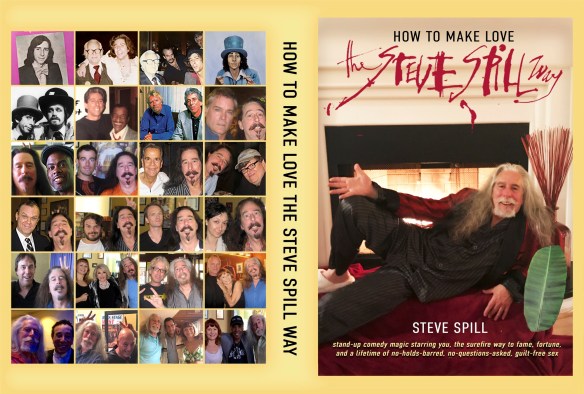
How To Make Love The Steve Spill Way

COVER_v2

***

If Lenny Bruce were a magician, he would be Steve Spill.

Lenny has long since passed onto that great big comedy stage in the sky, but fortunately our friend Steve Spill is alive and well and has come out with a new book aimed at magicians called How To Make Love The Steve Spill Way. His first book, I Lie For Money, was aimed at a general audience and contained lots of advice on how to live a creative life. It was served along with large dollops of autobiography and spit-take funny stories about the people he met along the path while building an artistic life for himself. In this new book, Steve not only continues his general advice for would-be artists, but also gives up the details of a dozen of his most creative and hilarious tricks. It would be an understatement to say that I think everyone interested in performing magic should read this book.

It’s always a great gift when a wonderful performer tips the secrets of his act, but it’s an even greater gift when the performer himself does the literate and humorous writing chore. Because it’s in that act of writing that Spill divulges his biggest secret: the most powerful thing a performer can do is to find her or his own quirkiness and unique qualities and put them out on display in a performance-oriented way.

When you read one of Spill’s books, you instantly understand what he’s talking about when he says to trust your own personality, because the pages of his books are drenched in the unique persona which he has nurtured. While on the one hand it’s instructive to pick up a Dai Vernon book written by someone like Lewis Ganson, on the other hand, the fact that Ganson, not Vernon, wrote it deprives the reader of real insight into much of Vernon’s personality. With a writer like Steve, though, it’s all hanging out there, and it’s plain as day. You understand immediately that the twelve killer presentations that Spill has detailed are perfect for Spill. Those who are not Steve would most likely fall on their faces if they did his presentations verbatim, but that’s not the point. The point is…who are you?

There are so many lessons to be learned here, not the least of which is the courage of one’s convictions. I read the beginning chapters twice, because the first time through I was laughing too much at the jokes to pay attention to the content.

But if you’ve got as warped and crazy a mind as Steve does (that’s a compliment, I think) there are bound to be doubts about whether anyone else will appreciate what you’re doing. However, Steve’s examples of himself being true to form, along with his constant brainstorming, testing, discarding, and revising of effects, serve as a model of what can be done, and act as a spur to one’s own creativity.

For each of the twelve effects Spill describes, he gives the background story on how and why he created it, and these stories are useful adjuncts to understanding how to create your own effects. The methods are tried and true, and for the most part they probably won’t surprise you with their cleverness after the fact. But that’s not what Steve is after—what will surprise and delight you is the way that Steve takes an effect from column A and a presentation from column Z, and juxtaposes them to create something never seen before, something to amuse and mystify an audience, which leaves them with the impression of a strong magical personality and experience.

What’s in the tricks section? Well it’s a compilation of Spill’s greatest hits—The Lemon thing, the Needle thing, The Himber Ring thing, the drug and hemorrhoid jokes, they’re all there, with full scripts and extra handling  and performance tips explained with loving care. The most audacious routine is one called “Abra Cadavers” which involves, well, a tale of cadavers wrapped in a personal story of tragedy. You would have to be nuts to perform it. I’m happy to report that Spill has done it many times, and tells you how to do it so that you too can be the object of abject speechless horror. I also thought that the presentation given for the UltraMental Deck was one of the best ideas for it I’ve ever come across.

At the end of the nineteenth century, the British magician David Devant expressed his appreciation of his audience with the tagline, “All Done By Kindness.” Likewise, Devant’s American contemporary, Howard Thurston, would prepare to go onstage by intoning in the wings to an imaginary audience, “Thank you, thank you for coming to my show tonight. God Bless You.” And now in the same spirit, as we navigate the twenty-first century, Steve Spill urges us to make love The Steve Spill Way. His love for magic, his love for his audiences and for his unique self are all part and parcel of How to Make Love The Steve Spill Way.


“I’ll Keep Doing It…Stubbornly”: Philip Roth

***

Author Philip Roth died yesterday. I can’t think of a novelist who has had more of an effect on me than Roth. Indeed, I don’t think I fully understood what a novel could be, and what a writer did, before I read Roth. When I am writing and I can’t figure out what to do, I ask myself WWRD–what would Roth do. The work ethic, the imagination, the dead-on ear for human speech and obfuscation, the love of language, all made him my favorite American author.

Above is an interview Roth did in 2004, where he talks about the obligations of writing. He also makes a startling prediction about the fate of novels in the near future. I hope he is wrong.

Thanks to Youtuber PBS NewsHour

Quote Tag

Quote-Three-31

Masercot of the very funny humor blog Potatoes and The Promise of More Potatoes has tagged me to play the blog game “Quote Tag.” The way it works is this: a blogger nominates from three to six other bloggers; then each blogger has to name a 19th-century author and provide three to nine quotes from that author. In order to keep the game going, each blogger subsequently nominates three to six other bloggers.

I’m going to cheat a little by picking George Bernard Shaw as my choice of author.  His 94-year-old vegetarian life spanned across the 19th and 20th centuries—see that’s what happens when your diet is based on kale smoothies. The great thing about Shaw is that practically everything he ever wrote or said is quotable, so for lazy me, it’s an easy post.

So here we go:

1. “The reasonable man adapts himself to the world: the unreasonable one persists in trying to adapt the world to himself. Therefore all progress depends on the unreasonable man.”

2. “There are two tragedies in life. One is to lose your heart’s desire. The other is to gain it.”

3. “Never wrestle with pigs. You both get dirty and the pig likes it.”

4. “We learn from experience that men never learn anything from experience.”

5. “My main reason for adopting literature as a profession was that, as the author is never seen by his clients, he need not dress respectably.”

6. “Forgive him, for he believes that the customs of his tribe are the laws of nature!”

7. “In literature the ambition of the novice is to acquire the literary language; the struggle of the adept is to get rid of it.”

8. “If you want to tell people the truth, make them laugh, otherwise they’ll kill you.”

And here are the names of  some bloggers for whom I’d like to pass the game onto (and whose blogs you may very well enjoy visiting):

Learn Fun Facts: Edmark Law’s daily blog of historical, mathematical, and lexical facts

Every Day Another Story: Homespun folk music and stories

McPhillamyActorBlog: Actor Colin Mcphillamy’s blog about his life in the theater

Book Nook, Magic Edition (3)

magic-book-zodiac-signs-1440x900

Every once in a while I like to catch up and share the titles of conjuring books I’ve been reading, so here’s what I’ve been enjoying the last couple of months—and a little product review at the end as well:

1. Scripting Magic, Volume 2: Pete McCabe’s first volume, Scripting Magic, was one of my all-time favorite magic books. It contained scripts for dozens of excellent magic tricks, and what’s more, it told you why they were good scripts and compared them to the not-so-good examples. Anyone reading them could improve the effects they already did by following the advice in the book. Now, in Volume 2, McCabe continues with more wonderful tricks and scripts—including examples from America’s Got Talent winner Derek Hughes, and the script of Houdini’s performance of the Water Torture Cell. McCabe tells you not only what makes a good script, but also helps you to understand how to come up with a premise, and how to flesh it out. It’s terrific advice, but even if you choose to ignore it, there are some very good tricks here including “Pleasure To Burn” ( a fifty-two to one card equivoque) and the holiday-themed “Catching a Leprechaun.”  While it’s always great to learn new sleights (and McCabe teaches a few here in the context of a given effect) probably no investment of time will improve one’s magic so much as focusing on script and presentation.

2. Malini and His Magic: Dai Vernon was always humble about the debt he owed to the magicians whose work he studied, including Emil Jarrow and Nate Leipzig, but none impressed him more than Max Malini. I’ve written about Malini before, but it is hard to overestimate what an important influence he was on Vernon’s generation of magicians. In an age where magicians mainly entertained with large illusions on stage, Malini changed the paradigm. Whether he was entertaining on the stage of a large theater, a hotel ballroom, or an intimate dinner party of the rich and famous, he needed only a couple of decks of cards and some silverware to make his presence unforgettable. In Malini and His Magic, editor Lewis Ganson collated Vernon and others’ thoughts and memories of Malini in order to produce a slim but valuable volume. It starts off with some basic biographical information, and then describes the presentation and methods of Malini’s full evening show, the highlight of which was his card stabbing routine. Later chapters deal with Malini’s more informal shows, and it’s wonderful to read about how audacious his effects and methods were. Malini was also quite a self-promoter, and not a small amount of his success was his ability to “schmooze” and make friends with wealthy patrons. The one secret that remains is the famous dinner table production of a block of ice from a lady’s hat. While Vernon describes the production and one aspect of the method, he admits that he does not know how Malini loaded up. That will have to be a mystery to all but Ricky Jay, who you can see perform the astonishing trick for a skeptical journalist in the documentary film Deceptive Practice. (Hmm, I just got an idea of what may have happened.)

3. Our friend Ron Chavis is now well along with the publication of his “Official Magazine for Mentalists,” Mystic Descendant, having released a solid four quarterly issues to round out the first year. The magazine continues with its friendly, good-natured, bar-room mate outlook, and as I have mentioned before, it focuses mainly on the casual performance of mentalism, with a focus on storytelling. I’ve finally caught up with the fourth issue, and in it you’ll find a lovely true story about a seance that unexpectedly turns into a tribute to a recently deceased mentalist; a presentation of an effect that leaves warm feelings of a spectator’s meaningful relationship; and an interview with South American mentalist Mauricio Jaramillo who talks about preparing for the time when things go wrong in performance. It’s light, pleasant reading, that may well stimulate mentalism thoughts of your own; if you haven’t picked up a copy yet, you can go to http://www.lulu.com/spotlight/mysticdescendant to order any issue.

4. On some of the internet magicians’ forums, you’ll find endless discussion of what are the best cards to use, and it may seem amusing to run into spirited online discussions that go into scores of pages on whether blue-backed or red-backed cards are best to use. A lot of magicians take such things quite seriously. Anyway, much virtual ink has also been spilled about what brand of cards is most suitable for card magic. For the past few years, the product of a relative newcomer in the field, the Phoenix deck by Card-Shark, has found favor with many magicians. I like Phoenix cards a lot, but I recently became aware of the new release by the US Playing Card Company of a special edition of their Maiden Back cards. I’ve been using them for a few months now, and I really like them, maybe more than the Phoenix cards. Here’s what I think the advantages of them are:

  1. They faro out of the box very nicely. They are traditionally cut, so if you’re a top down faro person like me, you can just turn the cards face up. The cards are so amenable that I don’t mind the difference for me at all.
  2. The cards are slightly thinner than regular Bicycle stock, and seem more flexible. It makes shuffling and general handling easier.
  3. The cards fan well and keep their fanning ability even after a period of time.
  4. Each deck comes with two identical jokers, a blank card, and a DB. Good times!
  5. The cards will make fans of Boris Wild and Ted Lesley very happy, if you get my meaning, wink wink, nudge, nudge; quick, and from a distance too.
  6. The factory sealed decks are in Tamariz order. Even if you don’t know that system, what it means is that with a copy of Mnemonica to inform you (see chapter five, especially) you’ll be able to do poker routines, including any poker hand called for; bridge demos; story deck effects; and finally you can convert to stay stack and New Deck Order with some (admittedly fancy) finger flinging. All this straight out of the box. And if you do know the Tamariz system, well…
  7. The card box is subtly differentiated so that you won’t mix it up with your other decks.
  8. Penguin is selling them now for $60 a dozen, which is a totally ridiculous price for cards with the last three features. They can be your everyday decks.

So if this sounds like something you might be interested in, I’d advise you to try a brick soon, as I don’t really see how they can keep selling them at this price. Happy magishing.