Roomful Of Teeth

150408-roomful-teeth-shoot-ayala-edit-0726

***

***

Roomful of Teeth is an intriguing a cappella vocal ensemble devoted to expanding the range of the human voice.  At the 56th Annual Grammy Awards, their debut album won a Grammy for Best Chamber Music/Small Ensemble Performance and in 2013, group member Caroline Shaw won the Pulitzer Prize for Music for her vocal composition Partita For 8 Voices. 

I spoke with the founder and artistic director of Roomful of Teeth, Brad Wells, who talked about the company, the human voice, and more.

You can listen to the interview as broadcast today on the Arts Express radio show on WBAI 99.5 FM NYC and Pacifica affiliates across the country by clicking on the triangle above. You’ll also hear some of the extraordinary vocal work of the ensemble.

Viv And Bev At The Border

IMG_1688

IMG_2197


***

***

Vivienne and Beverly Shalom are two artist-activists who, I’m also proud to say, are my sisters. I got to sit down and talk with Viv about the weeks the two of them spent together at the Arizona/Mexico border working with various sanctuary groups. In this interview, which was broadcast on the Arts Express program on WBAI radio in NYC, Viv talks about the migrant families she met, the art projects she did with their children, going into the desert to leave water for migrants, the Scott Warren Trial, and how the experience affected her.

You can listen to the interview by clicking on the triangle above.

The song in the intro and outro is “El Hielo” by La Santa Cecilia. You can learn more about it here.


Stevenson–Lost And Found

Stevenson Lost and Found 7

***

***

As readers of this blog know,  I’m a longtime fan of cartoons from The New Yorker magazine—and the man who wrote and illustrated almost 2000 of those cartoons was a prolific artist named James Stevenson.

But Stevenson, as Sally Williams’s new film documentary, Stevenson—Lost and Found, uncovers, led an unexpectedly complicated, rich, varied, and sometimes dark artistic life. I was happy to talk with Ms. Williams, the director and producer of the film, about her film and her enigmatic subject.

Click on the triangle above to hear the radio interview, as broadcast today on Arts Express on WBAI 99. FM NYC, and Pacifica affiliates across the country.

Up On The Air: Michael Apted

63

***

***

You may know of the great British director Michael Apted for his thrillers including the James Bond film The World is Not Enough, or you may know him for his outstanding work with Sissy Spacek in the Academy Award-nominated Coal Miner’s Daughter, or his work with Jodie Foster in Nell. But for many, Michael Apted’s greatest achievement was begun 56 years ago when he selected 14 British schoolchildren from different social and economic classes for the documentary called 7 Up. He subsequently chronicled their physical, emotional, social, and mental lives in ongoing 7-year installments. In a remarkable coup, Apted is now releasing 63 Up, and the 7-year-olds we met in 1964 are now all 63 years old.

I was lucky to interview Mr. Apted for the radio program Arts Express. Click on the triangle to hear the interview as broadcast today on WBAI 99.5 FM, NYC

Fifth Anniversary: Favorite Posts Of The Last Year

black and brown long coated dog birthday

Photo by Natasha Fernandez on Pexels.com

***

Yesterday, I put a wrap on the fifth year of this blog (put your favorite emoji here), and in keeping with my annual tradition, here are 25 of my favorite posts of the past year created by the Shalblog Industries® team. In no particular order:

A Child’s Garden of Denial

Three Secrets

Letter To A Principal

I Dream of Genii…

Permanent Record: Edward Snowden

Three Poems

Where Eagles Dare

Coriolanus: The Nihilism of War

“…Followed By The Pound Sign…”

Online Ordering

“I Would . . . Prefer . . . Not To . . .”

Woman At War

Two Schools of Magic

Federico Garcia Lorca And The Duende

You Don’t Look A Day Over 450

How To Produce Interviews For Radio And Podcast

Whoa, Nellie!

Kids These Days: The Making of Millennials, Part One

“Hard Luck”: Sholom Aleichem

The Road Not Taken

The Five Boons of Life

A Hole In The Fabric Of Time And Space

“They All Want To Play Hamlet”

Gerald Deutsch’s Perverse Magic: The First Sixteen Years

“We Don’t Need No Stinkin’ Badges”

Thanks for an enjoyable year and all your comments and support so far!

Super Size Me 2–Holy Chicken

SSM2-poster

***

***

In 2004, filmmaker Morgan Spurlock ate an exclusive diet of McDonald’s food, morning, noon and night, for a month. He made a very successful movie about the effect it had on his body called Super Size Me. Now, 15 years later, Morgan Spurlock is trying his hand at chicken with a new movie called Super Size Me 2 –Holy Chicken.

I interviewed Morgan recently, and he discussed the chicken and public relations industries, and the effect of Big Agra on family farmers. Morgan also brought along two farmers to the interview, Jonathan and Zack Buttram, who spoke of their devastating personal experiences, and how they were caught up in a cycle of debt and and exploitation.

Click on the triangle above to hear the interview as broadcast today on the Arts Express radio show on WBAI 99.5 FM NYC.

When Did You First Know…

***

Dame Edna with Kd Lang in a hilarious and charming segment as Ivana Trump looks on!

Thanks to YouTuber langsense


Billie Holiday: The Last Interview

billie

***

***

This new compilation of interviews with Billie Holiday has an introduction by journalist and writer Khanya Mtshali. Listen to my conversation with Ms. Mtshali, as broadcast today on Arts Express radio on WBAI 99.5FM NYC, as she explains why Billie Holiday was not the person you thought she was.

From The Ear To The Page: Nuclear Activist Helen Caldicott

adult apple device business code

Photo by hitesh choudhary on Pexels.com

***

Recently I’ve been playing around with making hard copy transcriptions of some of the radio interviews I’ve done, and I’m happy to report that I’ve discovered an Internet browser-based transcription service that I can highly recommend. It’s called Transcribe and can be found here:

https://transcribe.wreally.com/

The versatile service allows you to upload an audio file, which then returns a written file in a short time.  I would say the accuracy is above 90% if the sound is clear. It also allows you to correct and make additions to the written file by providing various tools including an audio player that can play the audio at a slower speed while you make corrections in an integrated word processing window. You can then export the completed file into Word (docx) or txt formats.

You can also dictate in real time directly into the service, although I haven’t tried that.

The price is quite reasonable, based on the length of the recording and a yearly sign up fee. Below is an example based on a 15 minute radio interview; it took me about an extra 20 minutes of formatting to get it into shape after using Transcribe. It would have taken me hours and hours without the service, so it was definitely worth it to me.

On this month’s anniversary of the nuclear bombing of Hiroshima and Nagasaki, and the recent Skyfall nuclear explosions in Russia, I thought re-visiting this interview with nuclear activist Helen Caldicott would be particularly timely and relevant.

***

JACK SHALOM: With tensions between nuclear nations ratcheted up to levels not seen since the Cuban Missile Crisis, the necessity of world action to ban such weapons is more important than ever.

Our guest, Dr. Helen Caldicott, has been a tireless anti-nuclear activist for over 40 years. She’s the co-founder of Physicians for Social Responsibility, author of several groundbreaking books including If You Love Your Planet, and was named by the Smithsonian Institute as one of the most influential women of the 20th century. She’s also the editor of a new book Sleepwalking to Armageddon, a wake-up call collection of essays about stopping the nuclear madness.

I’m happy to welcome Dr. Helen Caldicott. Hi, Dr. Caldicott.

HELEN CALDICOTT: Thank you, Jack.

JACK: Dr. Caldicott, in 1982 over one million people including myself gathered in New York City angrily proclaiming “No Nukes!” But now, thirty years later, the on-the-ground anti-nuke movement seems to have almost disappeared. What happened?

HELEN CALDICOTT: Well, what happened was that all of us together helped to bring the Cold War to an end, and finally Reagan and Gorbachev got together in Reykjavik and almost decided actually to abolish nuclear weapons in 1987. And when the Berlin Wall came down, all of us I think thought, thank God it’s over, we were so tired and exhausted, and we thought well, they’ll do the right thing and they’ll start getting rid of nuclear weapons.

And people and politicians starting talking about the peace dividend, but that was not good for the prevailing corporations of the time, the military industrial complex. They need wars to keep going and actually to steal the American taxpayers’ dollars to the tune of one trillion dollars a year. And unfortunately, because of that, and because of the power of the Pentagon, and because of the politicians and presidents who didn’t follow up on what the people desired, the weapons still stayed in place. True, many of them were decommissioned, but of a 16,400 nuclear weapons in the world today, Russia and America own 94% of them. So we’re still in a very invidious position where the whole of life on Earth could be destroyed with a decision by one man who is not entirely stable.

JACK: Do you think that we’re more in danger now that Trump is president, or is there an internal logic independent of any particular president?

HELEN CALDICOTT: Well, I’m not the only one who thinks that we’re more in danger. William Perry former secretary of defense is terribly concerned; General Cartwright, who is the chairman of the Joint Chiefs of Staff is deeply concerned; many people in Congress are, so yes, we’ve got a man who many psychiatrists have written about, saying that he is volatile, mentally unstable, impetuous, narcissistic, childlike. Really, I mean, Dr. Strangelove has nothing on this. This is a most extraordinary situation and yet we’re treating it with a kind of psychic numbing and manic denial. We’re not facing reality. The Earth is in the Intensive Care Unit and we’re sort of walking away and pretending everything’s okay.

JACK: Talk a little bit about launch on warning and how subject to human error these systems are.

HELEN CALDICOTT: Yes, well, the man who writes very well about this is Bruce Blair who used to be a missle-ier himself. He was a Minuteman, and they’re called Minutemen in the silos because they have three minutes in which to get themselves organized to launch their missiles. There are hundreds of silos in the midwest; in each silo is a missile with up to three hydrogen bombs on it. There are two men in each missile silo, each armed with a pistol, one to shoot the other if one shows signs of deviant behavior. So suppose the deviant one shot the other one? The missles are operated with floppy disks. They have telephones which often do not work. In the last couple of years about seventy-eight men of those of Minutemen have been dismissed because they’ve cheated on exams, taken drugs, gone to sleep down in the silos. The way it works is that a nuclear war would be initiated if satellites picked up missiles coming from Russia, but this can be misinterpreted—so, once a flock of geese alerted the early warning system.

JACK: One of the essays in the book quotes Los Alamos director Harold Agnew as saying he would require every world leader to witness an atomic blast every five years, because we’re approaching an era where there aren’t any of us left to have ever seen the Megaton bomb go off, and it’s it’s all computer simulated now. Could you speak to that a bit?

HELEN CALDICOTT: Yes. I think that most people now don’t understand what a hydrogen bomb means. And so I’m going to just describe a hydrogen bomb exploding over New York City.

Mind you, you have at least 12, but maybe 40, Russian, very large hydrogen bombs targeted on New York City alone. Each port is targeted, each tunnel, each bridge, and it goes on and on and on. Universities are targeted, and every town and city with a population of 50,000 or more is targeted with at least one hydrogen bomb.

Okay. So the bomb — the missile—takes half an hour from launch to land, and it will explode with I think it six times the heat inside the center of the sun, digging a hole three quarters of a mile wide and eight hundred feet deep, turning the dirt below the buildings and the people into radioactive fallout, shot up in a mushroom cloud. Five miles from the epicenter in all directions, everyone is vaporized, turned into gas as they were in Hiroshima; twenty miles out, everyone is lethally injured or burnt. People are turned into missiles, sucked out of buildings, traveling at a hundred miles an hour.  Shards of glass, popcorn from windows are traveling at a hundred miles an hour, decapitating people; and then the whole area would eventually be engulfed in a firestorm 3,000 square miles where everything and everyone would burn. Even concrete will burn; steel, aluminium and the like will melt. People in fallout shelters would be asphyxiated and pressure-cooked as the fire uses up all the oxygen in the shelter as happened in the Dresden firestorm.

Now that’s just one bomb, but consider that all cities across America and Canada are targeted and that the fire will spread even in the middle of winter. They will coalesce from north to south, east to west, and the whole of the US and in fact much of North America will be engulfed in fire. And it’s interesting that when the Pentagon calculates the damage that nuclear weapons produce, they only think about blast effects and calculate blast. They never talk about fire. It’s totally ignored which is fascinating in that in itself, but very, very dangerous. So it’s just one bomb on New York City. You’ve got at least 12, but some people say 40.

JACK: Extraordinary. You know, some of the younger generation of environmental activists in their zeal to ban fossil fuels have actually advocated for nuclear power. Could you talk about the relationship of the nuclear weapons industry to the nuclear power industry? And is it possible to be against one and for the other?

HELEN CALDICOTT: Well, not if you’re scientifically literate.

The main thing, I think about nuclear power plants and meltdowns at Fukushima and Chernobyl and epidemics of cancer, leukemia, genetic disease, congenital deformities and the like is the nuclear waste. Nuclear waste according to the EPA must be isolated from the ecosphere for a million years, because some of the isotopes last very very long, some of the radioactive elements. These elements will leak in whatever you put them in: concrete, steel, whatever, within a hundred years and it doesn’t matter how deep you bury them or what. They’ll leak and they will eventually enter the water and then they will enter into the food chains.

And when you’re eating a fish with cesium in it from Fukushima that swam across the Pacific, you don’t taste the cesium. You can’t smell it and you can’t see it. These radioactive elements are invisible to human senses. So what we’re leaving to our descendants is a heritage of epidemics of cancer, leukemia, genetic diseases, because these elements concentrate in testicles and ovaries and can damage the genes of future generations. There are over 2600 genetic diseases now described. My specialty is one of the most common, cystic fibrosis, which is a fatal genetic disease. Those diseases will increase in frequency not just in humans, but in all species. Plutonium, which is a potent carcinogen which lasts a quarter of a million years, crosses the placenta because it’s an iron analog. The body thinks it’s iron and then the first trimester of intrauterine life it can do what thalidomide did, deform the right half of the brain or the left arm.

JACK: And the plutonium, of course, that is created by the nuclear power industry is used for the nuclear weapons?

HELEN CALDICOTT: Yes, it takes ten pounds of plutonium to make a nuclear weapon. That’s the fuel and each reactor makes 500 pounds of plutonium a year, and it’s absolutely deadly. One millionth of a gram will cause cancer. So any country that has a nuclear reactor of course can make bombs like India did and Pakistan did and France did, and the like. In fact your reactors were based in Hanford, Washington, which is just a cocktail of radioactive waste leaking into the Columbia River which in the past has been the most radioactive river in the world.

JACK: So what can we do, or is it too late? What can be done?

HELEN CALDICOTT: Well, I mean, we should close down every single reactor right now and not make any more of this stuff.

JACK: But through what mechanism? I mean, how can this be done? How can–how can people on the ground effect the situation?

HELEN CALDICOTT: Oh, well, it’s through politics. You know, if enough people care and they’re potent enough, the politicians react; if the people don’t care, don’t know—the politicians, you know, are in the hands of the corporations and the nuclear companies and they’re in essence corporate prostitutes. I think people have to understand that the people in Congress are your representatives and you are their leaders.

JACK: As far as I know, there’s nobody from any of the major parties that I had a chance to vote for who called for the dismantling of nuclear power plants and nuclear weapons.

HELEN CALDICOTT: Well, then you must educate your representatives. If they don’t understand, you must go in with some doctors, physicians, and make an appointment, have an hour with them, and then educate them just as I’ve been talking tonight, so that they know what you’re dealing with, and what you demand. And then you must keep the pressure on and say, if you don’t do this, you know, we’ll make sure you’re not elected next time. And then you will door knock and write letters to the paper and get on television and get on talkback radio. As Jefferson said, an informed democracy will behave in a responsible fashion.

JACK: I wish we did have one. I think you might be overestimating the level of democracy in this country.

HELEN CALDICOTT: Potentially, you’ve got a democracy, potentially and it’s not being used, it’s being wasted. It’s a democratic vacuum at the moment because you know, people are into buying stuff and drinking their lattes and manic denial and displacement activity.

JACK: Is there anything to feel optimistic about?

HELEN CALDICOTT: Yes, yourself. Think of what I did. I mean I turned up in America in 1978. I was on the faculty at Harvard, but you know, I was an alien, I was a young doctor, I was a woman, and yet because of my deep concern I revived Physicians for Social Responsibility. We recruited 23,000 doctors and I became one of the leaders of the nuclear weapons freeze, just because I was well informed and I was deeply concerned. Anybody can be a leader if they decide to do the right thing. After all, why are we here?

JACK: Well, thanks so much, Dr. Caldicott. I wish we had another half hour to talk. I know we’ve only scratched the surface here, and I would have liked to have gotten more into what everyday people can do, and what the limits are of the system we’re working under, but we’ll have to wait for another time.

HELEN CALDICOTT: Well, I don’t think there are any limits. I mean to my experience there aren’t, you just have to become a Joan of Arc or a John of Arc and get on and be determined and really look in the mirror every morning and decide what you’re going to do to help save the planet. We can do it. Otherwise, I wouldn’t even be talking. Well, thank you Jack. Thank you so much.

JACK: I’ve been speaking with Dr. Helen Caldicott, editor of the new collection of essays about stopping the nuclear madness called Sleepwalking to Armageddon. This has been Jack Shalom for Arts Express with host Prairie Miller.

“Nothing Here Is Real”

JulieTom_0841

***

***

The entertaining magician and mentalist Gary Ferrar (whose grandfather was a lion tamer) talks with us about his new show of mental illusions called “Nothing Here Is Real.” As a bonus, he performs a mindreading effect directed at yours truly on the air.

You can listen to Gary’s interview and mentalism effect, as broadcast today on the Arts Express radio program on WBAI 99.5 FM NYC, by clicking on the grey triangle above.

Our Individual and Collective Identities: Music And Why You Like It, Part Two

Nolan-2BComposingBW

***

***

A continuing conversation with composer and musicologist Nolan Gasser, author of Why You Like It: The Science And Culture Of Musical Taste. In part two of our interview with Gasser, we track down the connections of music to emotions, economics, class, politics, and psychology.

To hear part two of the interview, as broadcast today on the Arts Express radio program,  click on the grey triangle above.

You can listen to Part One of the interview here.

“I Like To-may-to, You Like To-mah-to”: Why You Like It, Part One

gasser

***

***

Why does one person enjoy listening to Mozart while another likes Taylor Swift and still another enjoys Kendrick Lamar? Nolan Gasser set out to uncover the roots of musical taste and ended up with a wide-ranging book about music, its origins, its structure, but above all else about Why You Like It.

Gasser, the author of Why You Like It: The Science and Culture of Musical Taste, talks with us about his Music Genome project for Pandora, and his explorations into the secrets of musical preferences.

You can hear part one of the interview I conducted, as broadcast today on the Arts Express radio program on WBAI 99.5 FM NYC, by clicking on the grey triangle above.

You can listen to Part Two by clicking here.

How Low Can You Go?: Bob and Ray

***

Another hard-hitting interview by Bob of the Olympic world-champion low jumper.

Thanks to YouTuber Donald Williams

Whoa, Nellie!

nellie mckay

***

***

The wonderfully versatile singer, actor, and songwriter Nellie McKay spoke with us a while back, following her engagement at Birdland in New York City. You can listen to the interview as broadcast yesterday on the Arts Express radio program on WBAI 99.5FM NYC by clicking on the little triangle above.

Kids These Days: The Making of Millennials, Part Two

kids

***

***

Last week, I posted Part One of my interview with Malcolm Harris. Here’s how I introduced it:

“The young people tagged as Millennials have been called entitled, lazy, narcissistic, snow flakes and so on—but are those stereotypes the real deal? In his book, Kids These Days: The Making of Millennials, author Malcolm Harris investigates the political and economic forces that are squeezing and shaping his generation. In so doing, he also reveals some of the unique features of this stage of late capitalism.”

Now you can hear Part Two of my eye-opening interview with Harris as broadcast yesterday on radio station WBAI 99.5 FM NYC. The first part of the interview covered the life of millennials up to college; in this week’s Part Two, Harris focuses on the world of work, and why all of us, millennials or not, are headed in the same direction.

Click on the grey triangle above to listen.

You can listen to Part One here.

Kids These Days: The Making of Millennials, Part One

***


***

The young people tagged as Millennials have been called entitled, lazy, narcissistic, snow flakes and so on—but are those stereotypes the real deal? In his book, Kids These Days: The Making of Millennials, author Malcolm Harris investigates the political and economic forces that are squeezing and shaping his generation. In so doing, he also reveals some of the unique features of this stage of late capitalism.

You can listen to the first part of the interview I did with Harris as broadcast yesterday on Arts Express on radio station WBAI 99.5 FM NYC. Click on the grey triangle to listen.

You can listen to Part Two here.

“We Don’t Need No Stinkin’ Badges”

levine

***

***

In a world gone crazy, we might need to put the entire planet on the couch. Bruce Levine, a practicing clinical psychologist often at odds with the mainstream of his profession, argues in his newest book, Resisting Illegitimate Authority: A Thinking Person’s Guide to Being an Anti-Authoritarian, for the essential value of anti-authoritarians in a democracy, and questions their treatment by the medical establishment. He also dishes a few pro-tips on how resisters can survive the slings and arrows of an authoritarian society.

You can listen to my interview with Bruce Levine as broadcast this week on the Arts Express radio program on WBAI 99.5 FM NYC, by clicking on the grey triangle above.

Writers Under Surveillance

police blue sky security surveillance

Photo by PhotoMIX Ltd. on Pexels.com

***

***

What did Ray Bradbury, James Baldwin, Susan Sontag, Ernest Hemingway, and Hannah Arendt all have in common? They were all victims of FBI surveillance under J. Edgar Hoover. You can listen to my radio interview, which ran yesterday on Arts Express WBAI 99.5 FM NYC, with J. Pat Brown, editor of Writers Under Surveillance, a collection of FBI files obtained through the Freedom Of Information Act, by clicking on the grey triangle above.

How To Produce Interviews For Radio And Podcast

adult background beach blue

Photo by Lukas on Pexels.com


Thanks to my readers here for putting up with my seemingly interminable series on producing radio interviews. But now I have compiled and updated that series into one convenient 50+ page booklet which you can download for free here:

https://drive.google.com/file/d/1du7sr9jtjCRnQ34Cst3F7MEudifwcYyN/view?usp=sharing

I think it’s a pretty good way to start learning about interviewing technique, equipment, and editing for radio or podcast. It assumes you know nothing about radio and takes you from wondering about who to interview to the finished mixed audio file with bells and whistles. If you think you’d like to make a go at it, or are just curious, or would just like to see if your advice matches my advice, it’s all there in one convenient free booklet.

Go Forth and Interview.

Jiminy Glick Interviews Mel Brooks

***

When Mel Brooks realizes that someone else is even crazier than he is, you know he’s admitting defeat. Martin Short as celebrity interviewer Jiminy Glick reduces Brooks to helpless laughter.

Thanks to YouTuber The Official MEL BROOKS Channel

Radio Interview Production Workshop #13: The Home Stretch

IMAG0252

And…we’re in the final stretch. You’ve added an intro and outro to your interview, so now you’re going to mix it down to one track. (For the previous installments begin here and then follow the links at the end of each installment.)

First, select each track that you want to include in the mix by Command-Clicking in the left hand area of the track (Command clicking allows you to select more than one track at once). The three left hand portions of the selected tracks will now be highlighted:

select tracks to mix

Now go to the top menu and click on Track—>Mix—>Mix and Render to New Track

What you’ll find is a new track at the bottom which is the amalgamation of the other tracks you’ve selected to mix:

aftermixing

There it is, your completed track!. Now all that remains to do is to export it into a convenient format for broadcast. Typically, that would be an MP3 file. So select the final mix track and then from the top menu, click on File—>Export—>Export Selected Audio. You’ll get a dialogue which allows you to rename the file and choose its destination on your computer. You’ll also see, at the bottom, a section which looks like this:


after export

Set the File Type to MP3 Files, Keep the Bit Rate Mode to Preset, the Quality to Extreme, the Variable Speed to Standard. For saving mono files such as the ones we’ve been working with, select Joint Stereo. If you have been working with stereo files then you would choose Stereo. Click on Save and you’ll be presented with one more screen which you can ignore and just click on OK.

And that’s it. You should have an MP3 file which will pay in iTunes or any other standard music player.

I know this has been a long and sometimes technical tour, but the more you play around with this, the more you will be excited by the possibilities. It’s really amazing what you can make of your raw material.

Sometime next week I will post a link where you can download this whole series as one file.

Over and Out!


Radio Interview Production Workshop #12: Laying Down The Tracks

railroad tracks in city

Photo by Pixabay on Pexels.com

***

The train is rolling on. We’re now at the point where the text of your interview is basically finished. (For the previous installments begin here and then follow the links at the end of each installment.) Now you’re going to add some intro music and/or outro music by using a second track.

Before you do that, however, we’re going to even out the sound of the interview track by using the Compressor effect. Select the track (click in the left hand area of the track where it says Mono 44100 HZ or the like) and then select from the top menu Effect—>Compressor. You’ll see the following:

compressor

Ignore all the sliders and just click on OK. By simply doing this you’ll have done three valuable things:

1) All your red clipping areas will be toned down slightly so they are no longer clipping, and

2) Your sound levels will be smoothed out; that is, the relative distance between your high and low volumes will be lessened. This is particularly useful for situations with more than one voice or source, and

3) After the first two have been accomplished, your volumes throughout will be relatively increased to the maximum they can go without clipping. This process is called normalization.

I usually use the Compressor effect at this point even if I am not showing any clipping.

Now you’re ready to add your musical intro. You could conceivably just cut and paste a piece of music onto the beginning of your interview track, but it’s classier to have a separate track which will allow some overlap between the music and the interview, as if it were underscoring.

Let’s assume you have an mp3 file of music that you wish to use, or, for example, sound from an mp4 video from YouTube or the like. Your first job is to import that file into Audacity. So, select the file to Import by File—>Import—>Audio:

import

When the import is complete you’ll have a new track underneath your original interview track:

afterimporting.jpg

In this case, the track imported was in stereo, so we’ll change it to mono as we did before—by clicking on the black triangle (just right of where it says “music intro” in the photo above) and then clicking on “Split Stereo to Mono.” That will result in two identical mono tracks one of which you will delete by clicking on the “x” in the upper left hand corner of the track.

If you were to set the Play cursor to the beginning and click on Play you would now hear the music track and the interview track at the same time. If you only want to hear one track at a time, you can click on Solo on the left hand side of the track to make it the only track played (you’ll notice the other track is now grayed out instead of blue). Likewise, if you click on Mute on the left side, the track will become greyed out and quiet while the other track will remain active.

Typically, I like to have 20-40 seconds of music intro before the human voices come in, and then about twenty more seconds of music underneath the voices before I fade the music out. And on the tale end I like the music to fade up as I’m giving the closing credits and then take us out with the music fading out. So, how to do this?

To do this, we use the time-shifting cursor. It sounds much more magical than it really is. It’s just a cursor that moves things right and left. It’s in your toolbar above the tracks:

time shift

Normally, your cursor looks like the “I-beam” in the upper left hand corner above. We are going to change the cursor to the “time-shift” tool in the middle of the second row in the photo above.

Using this tool, I am going to pull the interview track to the right thirty seconds by clicking and dragging on the track. The result should be something like this:

shifted

So now, if we played both tracks, there would be 20 seconds of music by itself and then the interview and music together. Of course, the music would still be very loud and drown out the voices, so we have to lower the volume on the music when the voices come in. Fortunately, Audacity gives us a tool to do that fairly automatically called Auto Duck.

To use Auto Duck, we want to move the music track immediately above the interview track. ( It was difficult for me to get this right at first, because when I think of the “underscoring” metaphor, I think of music below. But in Audacity, the level of the interview track below controls the level of the music track above.) In order for this to happen correctly then, we must drag the music track to a position above the interview track. First, make sure you’re back to the I-beam cursor by clicking its icon on the toolbar. Next click in the left hand area of the music track right where it says Mono 44100 HZ, and drag it upwards above the other track. When you’re finished it should look like this:

after switching tracks

Now in order to “duck” the volume of the music wherever there is voice, you are going to select the music track (not the interview track under it) and then click on Effect—>Auto Duck. Ignore all the sliders and just click on OK. The result should be something like this:

afterautoduck.jpg

Notice that now the music volume is much lower above where the voice track is. You’ll probably want to take down the volume of the music even more which you can do with the Amplify effect, and then fade out the music over the next 20 seconds or so (you can then delete the rest of the music track).

For the outro, you go through a similar process: Import a track you wish to use, time shift it to the area at the end of the interview to the place where you want it to overlap the voice, and then use Auto Duck. Further correct with Amplify and Fade In, and then finally Fade Out as the music ends your piece.

This has been a lot, so save your work, and I promise tomorrow I’ll be back with how to make a final mix down to one track and then export your work. See you then.

The next installment is here: https://jackshalom.net/2018/11/10/radio-interview-production-workshop-13-the-home-stretch/


Radio Interview Production Workshop #11: Effective Effects

person standing beside another person holding fire poi

Photo by Rudolf Kirchner on Pexels.com

By now you should have a rough cut of your interview, which is approximately the desired length of your final mix. In this installment we’re going to get into some more tools of Audacity which will allow you to refine your work further. (For the previous installments begin here and then follow the links at the end of each installment.)

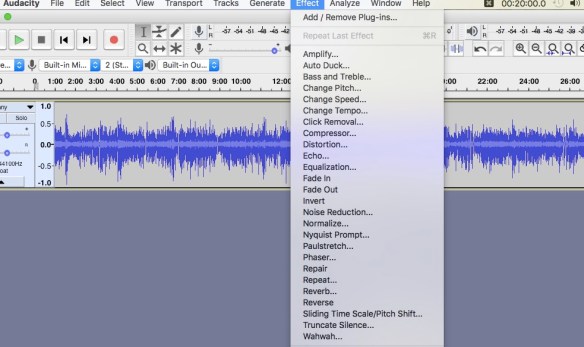
In the top menu, you’ll see a menu item, Effects. If you click on it you’ll get a long list of choices:

effects

There is so much that can be done with Audacity, but the truth is, to produce interviews and spoken word broadcasts, you will only need to use a few of the pictured effects. Of course, afterwards you can play around with all kinds of special effects such as Echo, Reverb, Wahwah, and so on for fun, but we are just going to concentrate now on the indispensable effects that you would need in normal use: Fade Out, Fade In, Amplify, and Change Tempo.

When you click on most of the effects,  there will be some default settings. The defaults generally give a good result, so I don’t recommend messing around with those settings for now. The first ones we will look at are the Fade In and Fade Out effects. Suppose you have clapping or music at the end that you want to fade out; you simply highlight the section on the track from the point where you want the fade to start to the point at the end where you want the sound totally muted. Then simply click on Effect—>Fade Out. You’ll see that you can use the effect over the same area more than once if you like. Likewise, with Fade In: often you want to fade in the music leading into or out of an interview. To do this, simply highlight an area and then click on Effect—>Fade In. Also remember you can always undo an effect with the Edit—>Undo menu item.

Next, let’s look at Amplify. An uneven sound level is a very common problem, and if the volume in general is too high or too low throughout the audio track, or variable throughout the track, we will deal with that later with an effect called Compressor. The Amplify effect, however, is most useful really for small areas where you need to bump up or tone down the volume. Perhaps someone turned away from a mic for a moment, or there was a loud unwanted background noise.

If you click on Effect—>Amplify, you’ll see that there’s a little box that says Allow Clipping. You want to make sure that that box is not checked.

clipping

Clipping means that the volume has reached such a high level that the sound is going to become distorted. Most of us have experienced that distortion when, for example, we turn up the sound to maximum on inexpensive speakers. So we want to be careful when working with sound that we keep the volume within certain limits, so that the vocal frequencies are not clipped. There are two main ways that clipping can be introduced into a mix: 1) either during recording, the source is too close to the mic and the recording volume is set too high (in which case most recorders will flash a red warning signal) or 2) using the Amplify effect in editing  the volume is too high and so clipping occurs. By leaving the Allow clipping box unchecked, Audacity will prevent you from bumping up the volume too high.

How do you know if you’re clipping? Go to View—>Show clipping(on/off). Make sure there’s a check mark next to it. If not, click on it.

view clipping

If the recording or the editing has introduced clipping, you will see it represented by red lines in the waveform:

red clip lines

While a  little bit of clipping is not a disaster, in general, you certainly want to avoid adding more. We will learn how to handle extensive clipping in the next installment, but for now, we don’t want to add any more of it through injudicious use of Amplify.

Amplify, interestingly enough, not only is handy for bumping up the sound, but also for making the volume softer when it needs to be. Your main control, after you highlight the area you wish to change, will be the slider you see when you click on Effect—>Amplify. Moving the slider to the left will decrease the volume (shown as a negative number of decibels); moving it to the right will increase the volume (a positive number of decibels). The general rough rule of thumb is that every + or – 6dBs doubles (or halves) the perceived volume (it depends upon many factors including the frequency of the sound and human psychology.)

The final effect we’ll discuss is a very useful one named Change Tempo. If you look at the first picture above, you’ll notice two other similar sounding effects, Change Pitch and Change Speed. But those are not going to be of much use to us. Change Tempo does something very interesting. Within limits, it changes the duration of a selection without changing the pitch. If you think about it, normally if you speed up a recording it also starts making the voices sound like chipmunks. But the Change Tempo effect shortens duration without affecting the pitch of the voices. It does so by cleverly shortening the spaces between words. Practically what that means is that if you are fighting to cut the last few seconds from a track in order to get within your time constraints, you can do so using this effect.

Now, to be sure, you cannot shrink the time of your track by very much before it becomes noticeable; I find, however, that you can submit a 2-3% tempo change cleanly without any apparent difference in sound quality—and the elimination of those few seconds (say, about twenty seconds for a fifteen minute piece) may be just what you need to make your time limit.

So there you have the most effective effects you can apply to your track. Next time we’ll talk about adding more than one track so that you can have overlapping music, and we’ll also talk about how to prepare your final mix for export. See you next time.

The next installment is here: https://jackshalom.net/2018/11/09/radio-interview-production-workshop-12-laying-down-the-tracks/


Radio Interview Production Workshop #10: Sculpting Your Interview

male statue

Photo by Emily Wilkinson on Pexels.com

So now that you’ve had some time to play around with some of the basic functions of Audacity such as cutting, moving, copying and pasting, let’s take a closer look at the editing process, and some more tools and strategies which will save you time and energy. (For the previous installments, begin here and then follow the links at the end of each installment.)

The most important strategy in editing, in my opinion, is working from big to small. That is, cut away the big useless sections first, and then start working more precisely. Again, sculpting is a very useful metaphor here: think of chopping away big blocks of stone before you start doing any polishing. There’s really no sense in beginning by obsessively cutting out each “umm” or “err,” if  that whole portion of the conversation is going to be cut out anyway.

What should you be cutting? Generally, you want to be able to cut enough back so that the listener can sense a clear through line of the argument or intention. Of course this is going to vary vastly from speaker to speaker. But it’s not uncommon for a person to say something like:

“I owe my life to Jane. Jane was married to a guy named Saul who worked in a little candy store down by the Bowery. He was a tall guy who always wore plaid and never liked me. In fact he went out of his way to avoid me. Anyway, Jane was the one who taught me everything I know about poker playing. She taught me how to count cards and bet correctly…”

Now if you have the time, you can leave in the bit about Saul, but really (and the “Anyway,” is the big clue) it would be more clear and direct to edit it so it said,

“I owe my life to Jane…Jane was the one who taught me everything I know about poker playing, etc.”

It is also often the case that a guest will make a statement and support it, say, with three examples. Much of the time, you can cut out one or two of those examples.

“I was always a dreamy kid. I would sing to myself in school and the teachers would yell at me for making noise. Then at home I would lock myself in the bathroom for hours reading books. My parents were flabbergasted by that. And of course when I was sick I would pretend to be the star of my own variety series and use the bed as a stage.”

They’re all fun to hear about, but if you are fighting for time, it could look like this:

“I was always a dreamy kid…When I was sick I would pretend, etc.”

But sometimes the cuts need to be even more drastic, and need to be made based on what topic you are going to focus on. For example, I had a very interesting conversation with a woman who had written a book about the history of segregated schools in the US beginning with the Civil War. I had to make a decision to focus the edited version solely on twentieth century history, with just the briefest nod to the important 19th century era. Sometimes you will be sad about what you had to leave on the cutting room floor, but it is all about working within the constraints you have.

Let’s look more closely at what needs to be done in Audacity to achieve these edits. First we’ll take a look at what I call the “name area” of the track on the far left. There are a couple of important functions hidden away here. And also some buttons and sliders you don’t want to mess with:

name area

The top slider button marked -…+ will change the volume level during playback. Leave this slider alone; there will be times when you want to adjust the volume levels, but you don’t want to do it from here. Likewise, the slider directly beneath it changes the output to the left or right speaker. Again leave that slider in the middle. Instead start off by clicking on the inverted black triangle at the upper right hand corner of the name box. When you do, you should get something that looks like this:

Name Controls

First I will name the track, by clicking on “Name…” at the top and entering a track name. In my example, I call it “penny interview.”

title traack

Since in my example, I started with a stereo track, and I want to work with a mono track, I click on the inverted black triangle as before, and then click on the line towards the bottom that says “Split Stereo to Mono.” (If your track is already mono, you won’t need to do this.) You will now have two separate identical tracks. You are going to get rid of the bottom track by clicking on the “x” in the upper left-hand corner of the name area of the track. (Remember you can bring the track back again by “Undo”-ing the action by going to Edit—>Undo).

Okay, so let’s say now you’ve decided on a chunk of the track you’d like to delete. Highlight the selection by dragging over the area with your mouse. You can extend the selected area right or left by pointing the mouse at the very border of the selection and waiting until it turns into a finger-pointing hand icon, then clicking and dragging the border carefully with your mouse.

Once selected, you can listen to how the track would sound without the selected part by pressing the “c” on your keyboard. You will hear a few seconds of sound from before the selection and then a seamless cut to a few seconds after the selection. In other words, this is what your track would sound like after the selection is deleted. This allows you to adjust the borders before you do the deletion for the best cut.

To help you achieve accuracy, you should use the Zoom function, by clicking on the magnifying glass with the “+” inside.

zoom controls

The more you click, the more zoomed-in you will be. To zoom out again, click on the magnifying glass with the “-” inside it. Notice the time markers immediately above the zoomed in track cover a much shorter length of time now in one screen.You would have to scroll horizontally to see more of the track. For example, this zoomed-in track only covers 33 seconds:

zoom time

This is a lot, so just one more thing about editing for now: if you want an edit to sound natural, the general rule is to cut on the breath. That is, leave the person’s intake of breath before s/he speaks. So let’s say the original audio was: “The CEO was incredibly incompetent and incredibly stupid. What’s more, he was a drunk.” If you want to edit  out the phrase “and incredibly stupid,” make sure to leave in the breath before “What’s more.”

After you make your cuts, save and quit, and next time we’ll talk about adding other tracks to your interview for texture. See you then.

The next installment is here: https://jackshalom.net/2018/10/19/radio-interview-production-workshop-11-effective-effects/


Come The Revolution…Part Two

68400843_High-Resolution-Front-Cover_7502482-200x300

***

***

A socialist revolution in the United States in 2044? In activist Mike Albert’s new fictional journalistic account, RPS/2044, you can learn how it happened. This is the second part of the interview with Albert that I produced for the Arts Express radio program. Mike talks about what a Revolutionary Participatory Society might look like, why it’s important for present-day activists to lay out a vision for the future, and how we might get from here to there.

Click on the grey triangle above to listen.

You can listen to Part One here.

(And for local listeners to Arts Express on WBAI 99.5 FM and wbai.org be advised that Arts Express has been moved to the new edgier time slot of Tuesdays at 11pm.)